

Networking Unleashed: Building Profitable Connections. An Interview with Dennis Meador and Michael A Forman
- mforman521
- Oct 16, 2025
- 31 min read

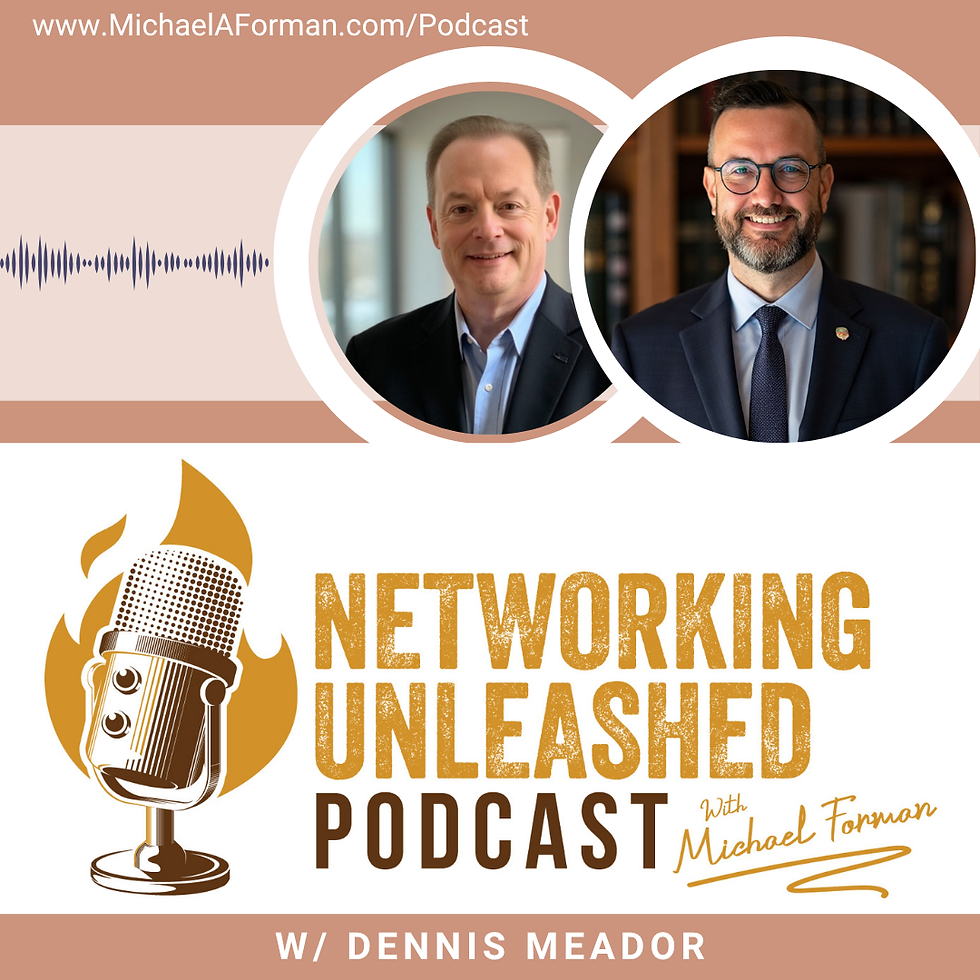
Welcome back to Networking Unleashed, building Profitable Connections, the show where we break down the art and science of building relationships that drive real results. I'm your host, Michael Foreman, and today we're diving deep into what really takes to build something from the ground up. Not just the strategy, but the mindset, the grit, and the bold choices that make it possible.
The, my guest today is someone who didn't inherit a roadmap. He created one, his journey about creating, about starting with nothing but a vision, using resilience, emotional intelligence and purpose to turn connections into a lifeline. If you've ever wondered how to network when you feel like an underdog, or how to lead with value when you have nothing but ambition, this episode is for you.
I'd like to welcome Dennis. Dennis, welcome to the podcast. And listen, why don't you give us a little bit about your background as well. Sure. I am a lifelong entrepreneur. Started into this whole foray at about 14 years old. Discovered very quickly that you can have a lot more success by enabling others to have success than necessarily seeking success solely for your.
Did that through my early teen years. 14, 15, 16. Then in my late teens, early twenties, started another company that actually took off very well and I was able to retire into Romania for about four or five years. I'd run the company a little bit. I had a partner, he ran it the day to day and I would ran I would did the 50,000 foot overview, but I ran it from phone cards and dial up internet in the early two thousands.
So I'm one of the first remote workers I like to jokingly say, because I did that for a series of a few years and that's been my whole career. I. Discovered shortly after actually that project. I liked working with attorneys, although I have worked with a number of different types of businesses throughout my career in marketing and branding and that sort of thing.
And that brings us to our current project. About a year and a half ago, my former partner exercised the option to buy me out. Fine. I, that's something I've never been scared of, is being out on my own. Starting over. That's status quo. And started this company the Legal Podcast Network. The launch date was May of 24 started with myself and my va no clients.
We now have roughly 150 clients, about 40 people on the team, and we're actually holding back our growth while we're working on some internal SOPs and things like that. Once those get done. It's really off to the races for us, then we're gonna really hit the gas on this thing. So that brings me to today I live on an island in Belize with my wife.
We got married a little over a year ago. We travel a lot. I run the business from my laptop, have my relationships all over the world via my laptop, via my phone, all of that. So that's what brought me to today. It sounds wonderful. It sounds great, and it really sounds like you have the eyes and ears of a true networking individual because you're doing it remotely, first of all.
But you started out with what's called a giver's gain. You look to help before you receive, and that I think is the most important part emotionally regarding networking itself. Be internally with what we do, we have a kind of a rule internally for every, so we use it, we break it up in five for every five things that you do.
Three of them should be a hundred percent value for with who you're doing them for. One of them can be 50 50, and one of them can be more self-serving than the o than, the other two categories. And so we always, we always say. 3 1 1 is what we say internally give 60 really 75% value and 20, 25%, just reminding them, Hey, this is what I do, this is how I could help you.
But always seeking value first. That seems like a great equation for anybody to have for them to be successful in business. So if you just keep, as a general rule, you can never go wrong. Okay. Let's start out when you were just starting out, how did you build your first meaningful connection and what did it lead to?
When I first, are you talking about back when I was a teenager? Or? Fast forward a little bit. When you first started out when you first started out, you were 14, 15, 16. So let's bring it to that. Yeah, I would say the first meaningful relationship that I built was actually the older lady whose door I knocked on.
That kind of helped me come to that realization that I didn't wanna shovel, I wanted to get the jobs, and my brother and his friends wanted to shovel 'cause they didn't want to get the jobs. And I remember going up to her, she was just a sweet lady. And I remember she handed me a 10 and two fives and said, for $20 shovel this, and this.
And I went back every time we, every time it snowed, every time it, there was leaves, for the summer for her lawn. And I be, I just knew, and she was, she was up a block down a couple of blocks and up about half a block. And I remember it. She, as soon as I was coming up the walk, she'd be like, oh, I'm so glad you're here.
And then she recommended me to a few other ladies that she knew in the neighborhood that needed help with, somebody mowing their lawn and that sort of thing. So that was probably one of my first if you would call it networking connections. I didn't see it as that at the time. It was just a nice lady who introduced me to more nice people that needed yard work done.
But I would say that very first person that. It wasn't our first job, but it was the first one where I realized, wait a minute, if I get the jobs and have the relationships with people, then my team can do the work and they don't have to have what's uncomfortable for them, which is interacting with people.
So I'd say, honestly, that was probably my first, one the second one I would say that would be more business was I took a paper route. The guy loved me and then I said, how many paper routes do we have around here? And he said. You can only do so many paper routes in a day. And I say, yeah, I know some other kids are like me.
And so he started every time a paper route. Somebody would complain or he'd wanna, he wasn't afraid to fire anybody within walking distance, because I knew I would get a phone call or he would stop by and he'd say, Hey, I got this route. Here's the map. And I'd go find somebody. They'd do that route, I'd collect it and we'd move on.
So that was probably my first networking, between those two. It conjured up so many memories for me, with my paper routes to begin with. But, it's funny because you figured out building the relationship before the client, before the customer base. And listen, most people didn't recognize that really until the pandemic, because it wasn't until after the pandemic when people realized that, oh, let me.
Deep, I have a deep dive. Let me gain this relationship over them, just being a customer. So you did this 30 years ago when it wasn't popular, so you really had a step above it really 'cause it, it shows your entrepreneurship, but it showed your mindset as well that you're putting the person first, above and beyond any work.
You have, you had have a great work ethic as well, so it all came together very well. Okay. What role has networking played in moments when you felt the most uncertain or lost in your journey? I have a lot of what I call business friends. I'll give you an illustration of a business friend back in early two thousands.
Now it's been, so it's been 20 plus years ago after I, I was kinda looking for the next thing to do. I got recruited by a company that sold to attorneys. This is how I got into it. Made friends with the guy who was the VP of recruiting or whatever it was, but he is the one who recruited me in.
He and I became friends 22 years ago. And we're still friends to this day. As a matter of fact, we've worked together, we've worked for each other, we've had businesses together, and now he's one of my salespeople. Although I've never met him except for one time in real life, he came to my house again, almost 20, about 20 years ago, he came to my house.
We shot pool, we talked. But this is a guy that for almost 20 something years, especially in different fits and spurts, we talked every day and so we'd bounce ideas, discouragements mind frame, and go off. So I think you have to have that network of people that understand what you're going through. Because when I go to my wife and I'm like, Ugh, this happened in the business.
This happened in the business, and it's just like. When you're on the outside looking in, especially if this is how you know, is a big way to take care of your family, sometimes I can put more on the people. I could put more on the people around me, like my wife, children, family, or even my people that are working for me.
But if I have people. That are experiencing and are in the same type of position that I am. Being able to have that person that understands and can give some insight, whether it's just, Hey, dude, I know what it's like, I've been through it. Or it could be, when I went through something like that, this is how I handled it and it really helped me.
So that's been the biggest advantage during those tough times, is having those, what I call business friendships, a number of them that I've had for years, and I keep connected with that. Maybe we make money together, maybe we don't. But we still try to be an encouragement to one another. And that's great.
You always want to surround yourself, whether it be virtually or not. With people like that, you don't wanna surround yourself with yes men, right? Because that doesn't get you anywhere. That just pats you on the back whenever you want. And that's fine, but it doesn't. It doesn't get you where you want to go when you have somebody say I had that same problem, but I did it this way.
And it makes you think. You may not take the criticism like a hundred percent, but you take a good part of it and say, oh, okay, you know what? Yep. I'm not gonna make that mistake. So I can see how that all comes in. Okay, so let's talk resilience. How do you stay connected to people when things aren't going well?
How do I stay connected to people when things aren't going well? I think that when things aren't going well, and it depends on really obviously the specific definition, but I think that, for me it's text, it's FaceTime, it's, it's, I live digitally. I've been all in on the internet since 2003, so 22 years.
Most, almost every business I've built since that time has been, rev has revolved around the internet in some way. And so I communicate digitally. So it could be Facebook, it could be FaceTime. It's any number of these tools. But that's what I do during those times is to stay connected with different people and learning their digital language and the people that you interact with is extremely important as well as, especially when you have a lot of business or what I also call virtual friends, because everybody has a preferred form of communic.
And I always like to use this illustration. Most of us know somebody who we might text them, we get no answer. Then one day we go on Facebook and we inbox them on Facebook and they instantly respond. And you're like, you couldn't have answered I've texted you eight times in the last two months, but that's because you now went into their realm and spoke their digital language.
And so being able to know like different people, I'll be like, oh, that's one of my. To Graham friends, that's one of my LinkedIn friends. That's one of 'cause I have to remind myself, like you might say, that's my friend from Texas, that's my friend from Ohio. I identify them by their digital language that they are most comfortable in.
And then I can reach out to those people and, gather them together from really across the world. Now that I've been doing this for so long and I've had people that have worked with me for me, alongside of me all over the globe my entire career. What do you prefer? As a way to digitally stay connected.
Right now business-wise, I would say it's probably going to be LinkedIn. LinkedIn has come become a place where professionals live and talk and network. It's really become a huge networking event. And, there's pluses and minuses to that, just like any sort of event, but it's like a virtual ongoing networking event that constantly happens.
That's a place that I live. Personally, friends and family. I prefer text and then I can text back when I'm not busy. And I try to explain to people, listen, just because my text doesn't bounce back as non-deliverable doesn't mean I'm available immediately. That moment, I'll set down my phone for sometimes a day, sometimes, six hours, things like that.
And I like the non friction ability to be able to text back and forth with people. Take a few hours here and you can still hold a conversation and stay. I don't like voice notes. I, because once it's said, it's gone and you can't continue the conversation. And I always tell people, they'll send me voice notes, voice.
I'm just like stop sending me voice notes. I only want you to text me. Why VO voice notes are easier. In the moment, they're easier for you. In the long term, they're harder for both of us because we have no way to reference back our conversation about this. Exactly. So that's, that, those are my preferred forms.
Exactly my feelings as well. Okay. Did you ever make a bold move in networking, like reaching out to someone way outside your league and what happened? Just recently actually, and I don't know if it's outside my league, but TEDx is doing a series in Roatan, which I'm in, like I said earlier, Belize, so it's just the next country down in Honduras or Roatan.
And so I was like, you know what, let's. Let's try to get on this stage for this. I wanted to, I'd set a goal to be on stage three times next year, 26. And so I thought this could be a huge jump towards that, especially if I could say as seen on TEDx. Now what happened was they actually ended up rescheduling the event to the spring.
But in the meantime, they invited me. They're launching a podcast and they've invited me to come on the podcast and teach about podcasting and remote work and, remote work culture and all of those things. So I fell short of my goal. I'm one of those people, I firmly believe this. I put goals beyond what I know are possible, because if I'm always looking at something that's impossible, I will fail and be and reach the improbable.
But if I set my goal as something that's highly possible, I'll reach my goal and stop there. So I would rather go beyond possible to improbable and fall short of impossible. And that's the way that I set my goals and that's why I do that. So I didn't get on the stage at TEDx, but I got on the podcast and so that's improbable.
It's not as likely, but. Not being on the stage, but I think it puts me in that universe and hopefully eventually gives me that opportunity to either do a talk or at least be on a X stage. Yeah no, it you're definitely on your way there. I'm on, I'm scheduled, do two TEDx talks in two different states.
But being on that podcast is like a middle way. And you're a, you're actually on their radar, so Exactly. So put you in a very good position. Okay. How did you build trust when you had no track record or brand? I've started several companies, so I think that's a very good question.
I think what I try to do in the way that I build trust is when I approach, because sales process development and digital marketing or marketing, product development, that's my, like core specialty. I could do other things as an entrepreneur, most people can, but the thing that like I'm best at, I know hey I feel like I'm in a.
In, in whatever percentage you wanna say top five, top 1% in that sort of arena. So typically what I do in order to build trust for a new brand or a new company, is very quickly I try to show what it is that we're doing. For example. When I launched this company, I have a buddy here on the island who is also a divorce attorney out of Miami, and he'll fly back and forth when he needs to.
He's got a partner who's a very well known criminal defense attorney. Matter of fact, I think he has like his own show on one of the major news networks or something like that, right? So what I did is I went to him and said, Hey, I'm launching this. Company. It's a podcast company for lawyers, you know you're gonna have a host.
You just sit down, takes about a half hour, you answer questions. Very simple. But what I want to do is have some examples of what we're doing, a finished product so that I'm not selling a concept, I'm selling them something they can see. Now you can sell concepts. I've sold concepts off and on my whole career.
But if you can actually have something to show them now they're like, and a lot of 'em. Would be like in the beginning, oh, I've seen that guy. I know who that guy is, the guy who has his own television show. And so there was just that built in opportunity. So what I try to do is very quickly build out the product as what I envision it to be, to show clients.
And then I actually go myself and I try to sell for the first year. Six months, 100 clients, whatever it is, and I develop the process and listen to clients and what is it that they doubt that if they, if I hear a couple of signs, yeah, I saw your website, I'm not interested. I go, I look at my website, I have people look at my website, what is on my website that is causing people to have doubts and have, oh, I think it's this phrase right here, and then we'll tweak it and try it.
And then I stop hearing that and I fix it. So that's what I do is I. Build slowly. I lead by doing, and then that allows me to very quickly take a product. For example, the Legal podcast Network, we launched it a year ago. No clients from what I can see, and now, again, don't quote me on this, but I only know of three or four quote unquote competitors and.
Only in that they do podcasts for lawyers as well. Their total marketing offering is different. Their pricing structure's well above mine. But in one year we went from not existing to being the largest network of podcast the largest attorney podcast network that exists. And again, that was just so now.
I don't have to build credit cred, credibility just a year into it. They know who we are. They probably know somebody who's our client and we can show 'em a ton of work and testimonials and everything else. So it just, but in the beginning, that's what I did, is I was the one there. I could answer the questions, I could overcome the issues.
That also let me know what I needed to build. In order to be able to hand off the sales process, what is it that people aren't seeing that I'm talking them over, but I can put in place to enable and empower a new person to come in and sell my product? That's great. So really you're, you went out and you saw what people didn't like.
You fixed it, you went a little bit further and you saw what those people didn't like. You fixed it. And this is also, you can hand it off to another salesperson to go out and sell, but they're getting the final, the finished product. So you exactly use all the grunt work. The first year. So yeah, they've got the finished product.
They've got the script of what to say. They've got the whole sales process, they've got the outline, they've got the follow up cadences, they've got everything they need, they lit. It's literally just plug and play. If you're a good sales person, I can plug you into my system and you can go. Sounds fantastic.
Really does. Okay. Have you ever built a relationship that didn't seem useful at first, but later turned out to be a game changer? I think there, I think we all have tons of relationships like that. I'm the guy that's sitting at the coffee shop that's and I'm on an island with a lot of tourists, every person that sits down next to me, oh are you visiting?
Are you or you, are you on the island now? I've been here long enough. I usually know if they're on the island, but I'm the guy that strikes up a conversation with anybody, so that enables me to be able to, take and, re can you gimme the way the question was worded again, I just wanna make sure that I'm.
Have you ever built a relationship that didn't seem useful at first Yes. But later turned into a game changer? Yes. So I have so many relationships. I have Instagram relationship, hundreds of them, hundreds of Instagram relationships. I have Facebook relationships. And what I mean by that are these are people that I stay in contact with on a regular basis.
And so when you have that much out there, anytime I say, Hey. The fruition of having such a large network over LinkedIn, over my phone, over Instagram, over Facebook, where I literally probably have. If you counted 'em all up, probably conservatively a thousand people that I stay in contact with. At least quarterly, some weekly, some monthly, some daily more my own family and a few friends.
But being able to have those relationships anytime I put something out there. There's help, there's an answer, there's a person, and it's usually, like you said, somebody I didn't expect. I build no relationships with hopes of what will happen with it and zero expectation. And that way when any of my relationships come to fruition, it's a bonus in my life instead of an expected outcome.
And it's, the only reason I do it that way is because that way. I don't monetize internally my own relationships. I don't wanna meet somebody and be like, how can they help me? And listen, that's the one thing I meet people who network and you can feel it when they have that sort of mind frame of, I'm meeting you 'cause I'm hoping you can help me somehow.
Versus the mind frame of somebody that's I'm meeting you because you're a person and I want to get to know about you. And that's it. And if something comes out of it, great, but if not, I'm okay as well. I am a firm believer. I said at the beginning, a givers gain. But, after I have a whole system of a networking event at a table and active listening and all that but when the person that I'm speaking to is finished or almost finished, I say, I like you and I like what you do and how you do it.
How can I make you more successful? How can I be a good referral source for you? And this releases any pressure that's on my back to perform or anything else. I'm just there for you and how can I make you more successful? So by doing so, that releases all the pressure and as you said, it's what you can do.
For the other person not have to worry about it. The sooner you can do that, the higher caliber of individual that you can interact with. So about a few weeks ago we had Simone Biles here on the island. She's half Belizean and she happened to be at this little bar right across the street from where I live with her football player.
I dunno if he's her husband or fi I can't remember it. It is. But anyway, I go in, I sit down and everyone's Simone Biles is here, Simone Bileses. And I was like, why isn't anybody like saying hi to her or anything? And they're all like we wanna be respectful. And I'm like, yeah, but if you don't interact with somebody socially, that's, you're just making 'em feel even more awkward, can you imagine you're sitting in the middle of the bar and no one's sitting here, no one's sitting on the other side of him, and everyone around you is and so I just went up to her and I said. I said Hello? I said, I hope you don't mind. I said, I'd like to just introduce myself.
I said, I live here on the island. And I asked her first, I said, and if you'd be open to it, if not, I wouldn't be offended, but I'd love to take a picture with you. And she said we don't really take pictures on vacation, what, just sit and chat for a minute and let's have a shot.
And we got shots. She bought shots. And then when we go to do shots, she goes, put your camera right there and turn on the video and me, and you'll be in the camera and the video taking shots together and high fiving or whatever. And I was like, okay. So although I did make them like had I not said anything about.
Asking for a picture. I did make that mistake, but you don't know how long you have. And you don't know how long they're gonna give you. But when she said, instead of saying sure, take a picture and use me as a prop of your life and move on, she said, no. Whether she, cognitively acknowledge this.
She said, no, sit down, talk to me like I'm a human and let's see what happens. And I think we do that. We walk up to somebody, we're like, can I take a selfie? And they're like, no, why don't you get to know me first? And I think when we lead with them and what they need, it allows us to connect to people.
'cause I've connected and listen, I'm not saying me and Simone Biles are friends on Facebook and she's coming over for Thanksgiving, don't get me wrong. But it does allow you to make connections with people who normally have an aversion to that. When you approach them with, hi, I want this from you, they're much more likely when you come in as just normal or even a way to help them.
Ab. Absolutely. Absolutely. Okay, so what do you think most people get wrong about networking and what's helped you do it differently? I think the thing that people get wrong about networking is saying, I'm networking and I'm a networker and I use networking. And then they go around and network and so everyone feels they're part of their little network harem that they're trying to build up in their mind instead of just walking around.
Being natural and being people. Being people and connecting instead of doing something, they saw at a book that says, ask this question and then send them two emails. It says this, and like I think networking is the last forum of marketing that belongs a hundred percent to humanity in that those who are the most human are the most successful at it.
I agree a thousand percent. I just got into a discussion with somebody beforehand about AI and how it works with networking, and I said, AI is great. It's a wonderful tool, but that's all it is a tool. You can't remove the human aspect. Of meeting somebody even through Zoom, because you're a person, I'm a person.
You still have to interact, so AI can't take away that, we've got a whole big discussion about it, but it's true. 'cause I don't ever want to remove the human of the situation and give it to. Something foreign, whether it's AI or something else. AI is a tool and we can use it. But much rather this talking back Exactly.
Exactly and we're a very AI forward company. I spend several hours a week looking at ai. I have a full-time young man who learns and integrates and tests out different AI stuff. And so I, while I a hundred percent believe that AI is a tool, the people that harness the tools are the one the most effectively are the ones that are gonna be most successful in the future.
Just like when it used to be, think about when, like the mechanic industry, they had their, their wrenches and they had a certain way they had to do things and then all of a sudden someone walked in and was like, and they've got this like power tool. It's like some of them at first were probably like, nah man, I didn't build up this muscle over the years in order to use some sort of machine for it.
But yet the ones who are like, if it takes me three minutes to do a whole car instead of 15 one by one, then let's do it. And just going through the whole car like that, and it's the same, like we don't see AI as what, like what you said is it's a tool to make us better. It's not a tool to replace us and it never will.
If we spot soulless humans, there's no way we won't be able to continue to spot solace machines. Right? Absolutely. Ab, absolutely. There are so many different areas, which I can go off on that, but I'm gonna try myself me too, myself. That's, I tried to keep in general myself. Yep. So am I.
So am I. Okay. How do you stay intentional with your connections as your world grows bigger and bigger? I think that's, that is really probably one of the biggest challenges for people. And so I think with every connection it has to eventually become a two-sided connection because if I'm in a net, a connect, if I have a connection, whereas if I fall off and.
They just never, they never make any effort. It's like a, any sort of relationship. If one person is the only one that's giving always, ever, and I'm not saying initially beginning to bring the walls down so you can connect, but just all they ever want is taking, or they'll never take their own time, then maybe it's okay to let some of those sort of fade away.
The people that keep my eye and keep my heart and keep my attention are the people that are just like, oh, haven't heard from fromer in a while. Everything good over there? You didn't, get eaten by a shark, did you? Ha. I think could, I think networking's a two-way street.
And when people, and I think that's why I talked about a networker versus a real person. That person that just keeps sending me stuff and sending me stuff and send, and I'm trying to politely by my non-action, say. Maybe this isn't the connection you're hoping because I don't see real advantage in my end, and so Sure, I'll be friendly to you, but I don't, we don't need to, we didn't connect in a way where I feel like we need to be best friends.
I think for me, I think the biggest example of this is real estate agents, and again, I'm using a generality, I'm not saying every single one of them. But do you know how many times me and my wife have been on this island and we meet somebody and they're just like, oh, I live here too. And we can usually tell within about 10 minutes of interacting with that person if they're a real safe.
They not even if they tell us, they don't tell us, but we can just tell the way. They're just like, oh, there's just it's like just above who they are. There's like a surface level. And so I, I think that. That's the kind of thing that allows you to show your genuineness over time. Yeah I agree.
I'm bringing it to real estate agents because that's the direction you went. But real estate agents always are in sell mode. They always do you have a house or are you looking for a house? Or, can I help you get a house? Or can I help you refinance? They're always in, in some mode. I have a few acquaintances here in Georgia where they're real estate agents and they've learned how to not use that at all.
Yeah. They're really going to the other person and they're seeing what the other person's about. They're not trying to. I have a house. You have a house, you know that, that type of thing. So it's a very small percentage of real estate agents or companies like real estate agents where.
The person can't get at, can't break through that, that, that barrier, you have to break through that barrier and kinda leave that and just see where the conversation goes and if it never enters into the realm of selling or buying or anything else like that, you leave it. Yeah, you leave it.
When you stay in contact with them whether through LinkedIn or something else, you're always. Adding a, an attachment of something in, in the housing market or something. You're bringing value to that relationship without Yep. Asking for anything Exactly. That's what I do. Looking back, how did your network support not just your goals, but also your purpose or personal evolution?
So I'll talk about a different network that I had. I was in a, in the church. Seen for about 20 years about 16 to 36. Taught in church youth pastor, evangelist, missionary, while having my own businesses. And that network obviously was very supportive. They supported me.
They helped me. That's the mind frame of the whole, sort of everything with church stuff, right? Is just like helping people and things like that. So I would say that, having that relationship or those relationships for their, those years. Now, unfortunately, a lot of times when you have a network that is very insular, sometimes what can happen is when you make big moves in life and you switch things up.
Me transitioning out of being in church life the way that I was. What can happen is if those connections aren't beyond just the thing that you're connected about, then when you separate, then there's just no more connection anymore. So I think one of the biggest ways to have meaningful connections is.
To make sure that you're not just connected because of one thing. Oh, you like this, I like this. We're friends now. But you've gotta find those, I think they call 'em invisible strings and things like that, that basically connect you in so many ways that if something happens where that primary thing, you were in a networking group together, right?
And then that networking group disbands. If that person was just there to network and not make real connections, they fade off from you. So that's. That's how I would answer that. You're a hundred percent correct. Because when you're building those relationships, you're not building it on a.
Church or networking group or something, you're finding something outside that realm that you can connect with. I use something called FORM, family, occupation, recreation, and a message, and I always have that in the back of my mind. Because I don't want to talk business. Yeah. So I'm either gonna talk about your husband, wife, sister, brother, son, daughter, whatever.
Not the occupation, but the recreation part of it. Oh, you like to ski or you like to boat, or you like to play baseball or something else like that. And we'll talk on that level. Way before we talk business. Yep. You know where you have gotten to today. You're a successful person, but I'm sure you've made mistakes along the way, so you're laughing.
So just give me one of your bigger mistakes and how did you get out of it?
Let me gimme, gimme a, a moment to narrow it down a little bit. Who likes one of entrepreneur. Yeah, exactly. I think there, there's, I think honestly, and this is gonna sound. Harsh, weird, whatever, because I'm a very trusting person and I've had a couple of business partners that have ripped me off, and I've had a couple of people that have worked for me that have ripped me off.
And so my biggest mistake has been either not balancing or finding a person that balances out that kind of side of me that. Because I'm a, I tend to be a little more forgiving and a little more, tender hearted towards people, and especially if they have things going on. I have been in situations where I know I've been taken advantage of, so I wish I, I could have that sort of just how much money are you gonna make me?
Like just a little bit, like 3% to where, I, I didn't find myself in situations where I'm like. I'm looking here in the last two weeks you've had me pay you for 80 hours of work, but I can find no more than 80 seconds, so that's probably one of the things I wish that I could go back and just like slap myself and be like, don't trust them.
Trust, but verify whatever, what you don't expect, what you don't inspect. And all of those principles that I've learned through the years is just being trust, trusting people, just offering things that had value and I shouldn't have maybe given it to 'em that quickly because then they just took it and ran with it.
So again, just. Just being transparent here, my biggest mistake throughout my career has been trust, trusting people that I shouldn't have. To the point of not having accountability for them, now that I have this business, I have five directors, they each direct each group of people. They bring the reports to me and their reports, I see all the client reports.
So it's a very different dynamic and each of those five directors has ownership of those five areas of the business. And then I just manage my five directors, and that's become a much easier way for me to insulate myself from having to do those things where I could be taken advantage of. Absolutely. I learned a long time ago when you go into business, you go into a business with your friend, which I would advise never to do, but Nope.
One thing you do is you write a contract, and even though you don't refer to it ever again or nothing, you take that contract, you put it in a safe, and you put it away just in case, in a year, two years, five years, 10 years, where, yep. Things tend to go a little awry. You can always refer back to the contract, exactly. That's what I've learned. Okay, so let's bring this podcast full circle. What advice would you give to someone who feels like they have nothing to offer when networking?
I would say, first of all, that's just a perception because. Sometimes the greatest thing you can offer per a person is just a chance to smile and chuckle a little bit. And so I think so many people think I have to be like dropping golden nuggets of wisdom in order to be of any value to people. But sometimes just coming in contact with a pleasant person who genuinely listens to you and makes you laugh a little bit and has a little bit of a story that bring, that makes your day.
That changes the dynamic of your mindset to where throughout the rest of the day. So what I would say is don't focus on what you can or can't bring. Just focus on being somebody who is present, who is there, and I think the moments. Will tell you what you can bring versus when we have something predetermined in our mind that's gonna happen.
Typically it happens, but when you don't try to predetermine in your mind the way a conversation is going to go, or the way whatever is, an interaction is going to go, you can have much bigger, better results and come away with something much greater than your initial desire was to have. Could be a new best friend, could be a new partnership.
Could be a new connection that helps your business, but you didn't come into it wanting, you came into it saying, I'm gonna be here, I'm gonna be present for this person. I'm gonna listen to them. I'm going to, offer what I can and see what happens. The people that have pierced through, the clutter with me are not the people that said the smartest things.
They're the people that said the most sincere things. And, I like to take that. It's the whole thought of networking, the word networking per se. I take them out of there 'cause I say you network wherever you go, whether it's a department store or grocery store or anything else.
I was like how do you act when you're in a department store or grocery store as when you're. Or in a networking event, it really shouldn't be any different. You have to be yourself. Yeah. And once you are that way, once you listen to the other person, then the whole world opens up. And it's an amazing thing once you understand that, that whole concept, so the most impactful people are the people that make us feel like they cared about us.
Yes. And people don't. I agree. Like that's such a hack. It's such a hack. People don't realize it. 'cause they wanna share their thing. I do this and here's this and here's that and here's the story and here's this. And listen, I'm as guilty of it as the next person. But when I purposely say, wait a minute, I'm just gonna be quiet and listen and ask questions and learn about that person, I've noticed that the people that I.
Because that's not my nature that I connect with in that way, that connection is much deeper initially than the ones who listen to my stories and laugh. And again, there was a little bit, laughter and things like this, but when I sit and listen to them, then they recognize me as somebody who cares in the future and somebody who cares versus I don't want to go talk.
He's gonna tell me a bunch of stories. I, you think you got a three minute combo and you're there 25 minutes later, that's the guy or girl that you don't want to be. Absolutely. Very good. Dennis I feel that I can talk to you for the next two hours because we are so much on the same wavelength, but if somebody wanted to get hold of you, what's the best way that they can get hold of you?
The easiest way is LinkedIn. Just go onto LinkedIn. Type in my name, Dennis, D-E-N-N-I-S, and then last name met. I'm sure it'll be in the show notes. Maybe this link as well, 'cause it's linkedin.com/in/dennis metter. So LinkedIn's the easiest way if they wanna see what I do, and you know what my clients think about it and the business side of me.
Go to the legal podcast network.com which is my company. And so you can see the two sides of me. More like with LinkedIn it's more, I do videos and content and it's not just about podcasting, although there's quite a bit in there or branding. I talk about all kinds of different things and just try to share what I think could be valuable to the type of people that I know.
Or at least I'm in their feed. I don't know how much they listen to me, but I'm in their feed. You never know. You never know. What I found with LinkedIn, they may not like or comment on what you've posted, but they see it because in a month, two months, three months, they're going to respond to you about, I say, I didn't even know you saw that post.
Oh no, I saw it. I didn't comment or like it, but I saw it so you could be seeing. From where everybody goes. But you can see that you'll, you're actually being paid attention to. Because again, it's not your network of people that you're talking to, it's your network of people. The network of the network.
So you're reaching out to much more, many, more people than what you're used to. But anyway. Dennis, I want to tell you, I wanna thank you so much for coming on the podcast and I hope to speak with you soon. Absolutely. Thank you for having me on, Michael.
Well, hold on folks. Don't go anywhere. Let's hear from our sponsors. David Neal, co-founder Revved Up Kids. Revved Up Kids is on a mission to protect children and teens from sexual abuse, exploitation, and trafficking. They provide prevention, training programs for children, teens, and adults. To learn more, go to RevD up kids.org.
Henry Kaplan Century 21. When it comes to making the biggest financial decision of your life, leave it in the hands of a proven professional. Henry Kaplan Henry is a global real estate agent with Century 21, celebrating his 41st year in business. No matter where you're moving, Henry, has the right connections for you.
You can contact Henry at 5 6 1 4 2 7 4 8 8 8.
Folks. A huge thank you to our guests for sharing such incredible insights today, and of course, a big shout out to you, our amazing listeners, for tuning in and spending your time with us. If you're interested in my digital courses being coached or having me come and talk to your company, just go to MichaelAForman.com and fill out the request form.
Remember, networking isn't about being perfect. It's about being present. So take what you've learned today. Get out there and make some meaningful connections. If you've enjoyed this episode, please don't forget to subscribe. Leave us a review and share it with someone who could use a little networking inspiration.
Let's keep the conversation going. You can find me on Apple, Spotify, Pandora, YouTube, or my website michaelaforman.com/podcast.
Michael is a business networking expert specializing in enhancing professionals' networking and communication skills to drive profitability. As a leading authority in this field, he is highly sought after for his dynamic presentations and workshops. His extensive experience has consistently led to significant improvements in corporate profitability by empowering individuals and organizations to connect more effectively and efficiently.
Digital Courses


Comments