

Networking Unleashed: Building Profitable Connections. An Interview with Greg Weinger and Michael A Forman
- mforman521
- Sep 19, 2025
- 33 min read

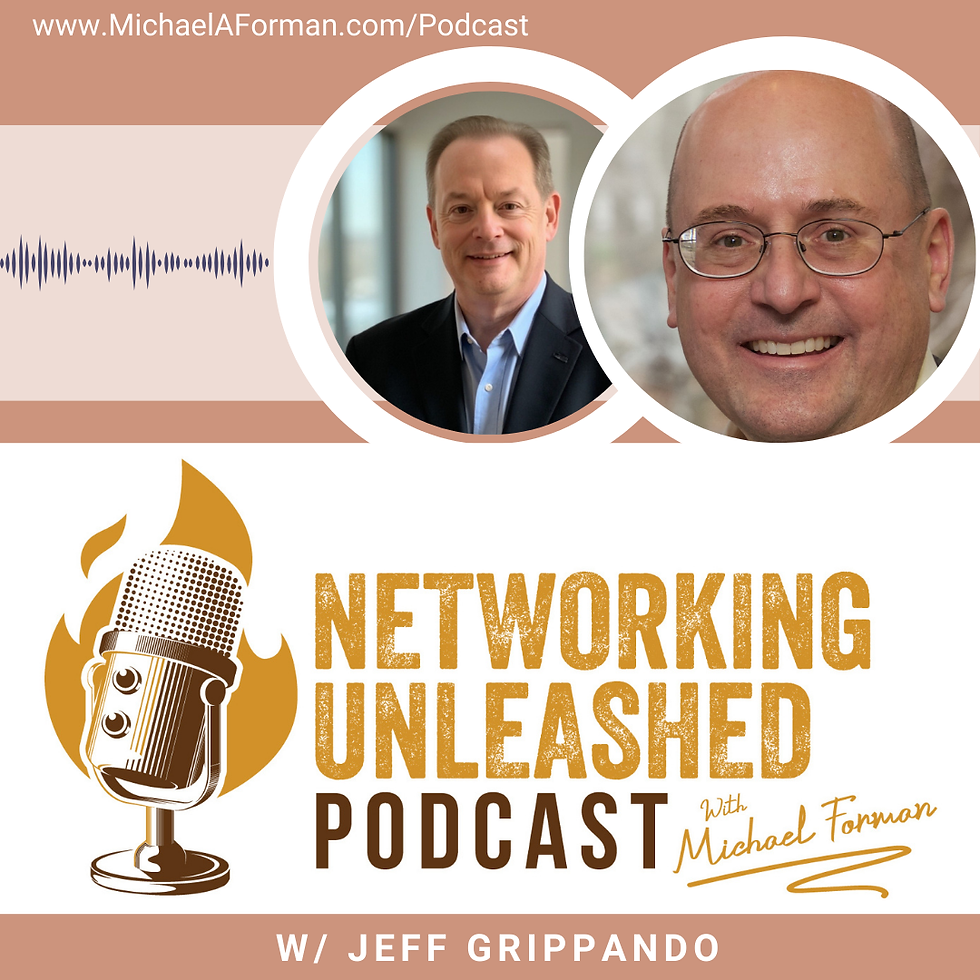
📍 📍 Both personally and professionally. His experience in leadership and mentorship gives him a front row seat to how meaningful connections can be. The difference between burning out and breaking through. Whether you're building a business, leading a team, or navigating life's curve balls, today's conversation will challenge you to see your network not just as contacts, but as catalysts.
So I'd like to introduce Jeff Gron. He's part of a larger company. I will let Jeff introduce himself and gives a little taste of his background. Welcome to the show, Jeff. I. Thank you, Michael. I appreciate it. Thank you for having me. Been looking forward to this conversation for quite some time to talk about my background a little bit.
It's interesting. I have to say I have a very decorated past and I owe that to my father. When I was in middle school my father got trans. I grew up in Chicago, Illinois. My father got transferred to Jackson, Mississippi. I was down there for a few years. He gets promoted again.
We move to Atlanta, Georgia. So I'm now in my second high school at this time. The summer between my junior and senior year of high school, my dad comes home and says, I just got promoted again. They want me to run the manufacturing facility out in San Leandro, California, which is in the Bay Area.
And we moved to California. So I went to three high schools in my life. And and the reason I bring that up is I was forced at a really young age. On how to make friends quickly and you had to put yourself out there. And I lost all fear of being shy, timid, what have you, because if I didn't put myself out there, I wouldn't have, I wouldn't have friends.
And so I joined every single club, played sports, got jobs when I turned 16, and I just started meeting people and and so forth. So I ended up going to college out in California and I started my career with a printing company. And and I was a salesperson out in San Francisco Bay area. This is 1990 91.
And I was trained by a very good company on how to sell print and how to build relationships. That was really, it was drilled into our heads very quickly. We sell consumable products, we sell print, we sell stuff that people have to use over and over again to run their businesses.
And so the message was people like. They buy from people they like. And so you, so the first thing you need to do is figure out how to build a relationship. And I think I had a lot of history doing that all through my middle school and high school and college years obviously. And I just became pretty good at it.
And I knew that I wanted to learn more about the company and work in a marketing role. And I was then transferred to Chicago where our corporate office was built. I then wanted to get into a sales management role, and I was moved out to Denver, Colorado, where I managed our sales office. And a variety of offices in the Rocky Mountain region.
And I continued to grow in my career around print, around branded merchandise, promotional products, all about marketing, all about brand. Brand was pretty much in my DNA. I eventually made my way back to Atlanta, Georgia and was fortunate enough to get promoted in running a branded merchandise division of a billion dollar company outta Dayton, Ohio.
And that's, I would say really. Accelerated my career a across a lot of different leadership areas, mentorship areas and so forth. But I would say if you ever asked me, when I get to retirement someday, and someone said, what was the best part of your career, I would say. I got to travel the country and actually work with and meet folks from some of the largest brands in the United States.
To be able to do business with Harley Davidson, Boeing to do business with jelly Belly. I've been in the Jelly Belly Plant in Vacaville, California. Coors Brewing Company progressive Insurance, Geico, just some massive brands and some wonderful people that I, had the fortunate.
Opportunity to work with. And and that's probably been the best part of my career. Now, five years ago, I, in the middle of COVID, I took this new position with a company called GBS Corporation. I'm the president of our printing and promotional product division. Our division is called GBS Brand Connect.
And I was fortunate enough to get this position because of an acquisition that, that GBS made of a a boutique agency called Atomic Wash Outta Norcross, Georgia an agency and folks that I did business with for at least 20 years prior to both of us becoming a part of GBS. And and it's been the past five years have been wonderful.
Been a lot of challenges, as you all know, since 2020. But we continue to to grow and, and to help customers advance their greatest asset, which we think is their brand. Absolutely. And I'm with in agreement with you a hundred percent since half of my life is branding and everything else also.
I agree a hundred percent. So let's delve into the question, shall we? Perfect. In your leadership journey? How has networking played a role? Not just opportunity, but in resilience? Oh, that's a great question. I think it's, in terms of resilience it's, and I would almost go back to being a, starting as a sales rep, it's you're faced with rejection every single day.
We're still obviously faced with rege rejection and. And it teaches you, and it forces you to think, how can I get into my walk in my customer's shoes, get into their, we used to call it, get into their odds are understanding their business and then being able to mentor a sales force to think and understand the same way.
No only means no for now. That's a pH the philosophy. And I think a lot of that comes through resilience and not getting frustrated and so forth. But I always like to tell my reps and I have the same philosophy. When you're having a bad day pick up the phone and call one of your best customers, one of your, one of your best relationships you have and just talk about the business and their lives and their families and so forth.
Or go out and have dinner with them or take 'em to a ball game or something. That always. Makes the day better and helps you get through those tough times. When you need to be resilient and patient and and always moving forward On top of that, to answer your question, I think the ability to set goals and objectives is very important too.
And, before you sit down or venture out into something new or start something different build a goal, build the objectives, build the action steps, and then hold yourself accountable. Hold your team accountable to what you wrote. All goals should be written down. You type, write 'em down, type 'em up.
They need, and they need to be posted somewhere. And then always go back and evaluate and review where you stand against those goals. Whether it's a weekly, monthly, or quarterly basis. I think that's very important in anybody's leadership style. Absolutely. I used to have a whiteboard behind my desk and I used to put my goals up there, and I very quickly realized that a whiteboard is erasable.
So one day when my brother, who was in the company at the same time changed a few of the words and I was in trouble, but putting your goals on, written down, on a ball, on something. Very good advice, and that's something I think that everybody should do. I'm, it's funny if you came into my office and I'll, you probably can't see it very well.
Oh yeah. But right behind me is two whiteboards and there's every single goal and objective for my business unit for 2025. And I actually, which this is interesting, and I'm a big believer as a leader manager, what have you, your teams need to be a part of that goal setting process, probably in November-ish of this year, I will gather up my director of operations, my customer service manager, my director of sales. I'll take a few key people off their staffs. We'll all go into our boardroom, down the hall over here, and we'll start building our goals and objectives for 2026. I won't erase that until January.
First, because we like to always go back and do a quick review. How did you finish the year? Document it. That'll all get erased. And then everything that we worked on in November and December, we'll go up on that board by January 5th, that board will be full of all of our 26th goals. So yeah, I'm the big believer in and looking at it every day.
I look at that every morning yep, absolutely. Absolutely. As did I, as did I. And in a mortgage business I had. 15 people under me. And they always saw the whiteboard when they came into my office. They always saw my goals, and they saw that I was serious. I wrote down my goals and I was serious.
And that was one thing that I hoped that they picked up on. And you, and as a manager of an operation yeah, that those goals and objectives, they should cascade down to everybody. So everybody's tied into, obviously my salespeople have specific goals. My customer service people have specific goals, but those goals should all.
Bundle up, roll up to what's on that whiteboard back there for the entire operation. And and I think over the years we've done a very good job of making this a team effort. Not just me standing here as a dictator saying, we're gonna do this. It's a team effort. That's we win and lose as a team, not as individuals.
That's always been my philosophy. Yep. That's key in leadership. That's key in leadership. You want to be a team, but your team, you have to create other leaders. You have to give them the responsibility and so that they feel like they are part of it. And so by them feeling part of it, they're more accountable and then you can hold them accountable.
So it's a whole big process, but very good. That's. Can you share a moment when a mentor or a key connection helped you overcome a major obstacle? Yes and I think the example that I'd like to give was I. We were challenged. It was a promotional product customer. This was in my previous job.
We were challenged by this organization to set up a separate operation in Mexico City. So this organization had a, had their headquarters was in Chicago. They also had another headquarters in Mexico City. 'cause that's where a lot of the products were manufactured south of the border and they wanted they wanted a website, everything in Spanish obviously.
They wanted a supply chain. Where they wouldn't have to pay duties and taxes. So as you may or may not know, a lot of our branded merchandise items are manufactured in Asia, in China. They come to the United States and that's where they're decorated. And so forth. And then if they were then shipped to Mexico, there's, you're paying duties and taxes, and nowadays tariffs, is the big, word of the day.
But they didn't wanna have to pay that, so we had to build a supply chain that went right from Mexico, right from China into Mexico. So it never touched the United States and. So forth. So I, it was a big challenge and my mentor at the time was was my chief executive officer. And he f first was very.
Negative on the fact of sending a team down to Mexico City. They were worried about our safety. Obviously, I had never been to Mexico City before and so forth, but the requests kept coming from the customer that this is something you all need to do. If you ever want to get into the European marketplace with us, you're gonna have to start here.
After I convinced my CEO, who was a great mentor to me, he was actually my, he was actually my vice president of of sales when I was a regional sales manager in Atlanta. So I worked for him for years and he was promoted to CEO. His leadership and mentorship around. The conversations we had of everything that we had to get accomplished and being able to sit down, document, meet regularly to go through that process.
He assisted in working with key decorators here in the United States. We found out who had operations in Mexico City. And we built a complete strategy of how we were gonna get this accomplished. Funny little story. At the time, we only had one gentleman in our whole company. I. And this is a billion dollar company.
One gentleman that spoke Spanish, that was bilingual, and he was he's actually still with this company. He's one of their sales reps in Miami in Miami, Florida. He was from Cuba. So he, when I first flew from Atlanta down to Mexico City, he flew over from from Miami that Sunday morning, and our folks from Chicago flew down and we all met up at the airport in in in Mexico City.
And, it was just classic having him there because none of us spoke Spanish. And and then it was an interesting experience, I'll admit it was a little scary the first time 'cause you hear about, corporate folks getting kidnapped and this and that, and they warned us and told us how to dress and what to do.
But but that. But that mentor was very, he's still, he's retired now, but we still talk and stay in touch and he's been a mentor to myself and and a lot of other people over the years. So that's probably the biggest challenge, or I needed him to assist me in my career. E everybody needs a mentor.
As big as you are, you always have a mentor. I feel, 'cause I have a mentor also, but I mentor. Other people. Okay. So I feel like I'm in the middle, everybody ask me because my, the people who I coach and who I mentor, they look at me and they say who do you have?
Because if we're asking for you for que problems, who are you going to? I'm to a higher authority. You know that. That's all I say. Yeah. But Exactly. Nice. That's all I know. Yeah. Okay. What's the difference between managing people and leading through relationships? Oh that's another good question.
You know what I, I think at a very high level when you say managing people, that kind of strikes me as an eight to five job. That's some, someone coming in, punching a clock, making sure that whatever needs to get done that day is getting done and so forth. I was always, and I, my other mentor in my life and he has passed away a couple years ago was my father.
And and I mentioned my father earlier in this conversation. And I used to go to work a lot with my father when I was, when I turned 16, when I was in college. I worked at that manufacturing facility out in California and then, my father. My father led by example, and he told me, long time ago that a good leader is a servant to their teams.
And coincidentally, years later, I'm in Denver and I have a new vice president of sales that I'm now reporting to. And I remember he walked into the office in Denver. And he'd be another mentor in my life too. I got great stories about him, but he handed me a little paperback book and it said A leader is a servant.
And I already had that philosophy that was in my DNA because of my father. And I read that book and I'm a true believer that you know what leaders you, you lead by example and you roll your sleeves up and you get in the trenches with your team. That's the one. The one thing I loved about my father was, we lived 45 minutes away from that plant that he was running and, he, his goal was to be in that office in the facility. 'cause the first shift started at 6:00 AM and he wanted to be in the building. He wanted to be one of the first people in there. He didn't need to be, he probably could have showed up at eight o'clock if he wanted to.
But he used to drag and I used to complain, here's a high school kid and we're getting up at four 30 in the morning and going to work every day in the summer. I'm home for from, for summer break during college. But boy, he that I saw what he did. I watched it with my own two eyes, and his people really respected him.
And because he led by example. And I think that's how I lead my life. You know what it's not beneath me. If we have a big kidding job going on right now out in our warehouse here, a hundred feet away from me. I'll go right out there and help them kid. A team gets the job done and it doesn't matter what your title is, you do what you need to do to get the job done.
And ultimately we all at GBS here, my philosophy is we work for our customers. That's who my boss is. My boss is all those customers that we service and have relationships with. So I think that's the difference. Absolutely. And really. The key to now I'm gonna combine networking with leadership.
Okay. So the key to networking there, there's a mantra. Know you like, you, trust you, they'll do business with you. So everybody knows the mantra, but when you go to a networking event, you go with a servant's heart. You go with you, you go for the act of giving, not receiving. So everybody thinks that you go to one of these networking events that you're gonna sell.
That's the absolute wrong idea. When you get to having a relationship with somebody, you say, you know something, I like you. I like how you do business. How can I make you more successful? How can I be a good referral source for you? And it usually blows 'em away. You don't even know what you do yet.
And you're saying, how can I be more successful? But that's what you do. So that's the mindset that you get in. So when you said having a servant's heart it's all over as long as you are authentic when you say it. And I want to tell you that there's an old book by Ken Blanchard Okay.
Called the Raving Fan. The rating I've read other books by him, but not that one, but, okay. Yep. It's a small book, right? I used to give out, give it out to realtors. When I was in the mortgage industry, it's a quick read, 45 minute read, whatever, but it's all about customer service. So that's I'd like to make another comment about attending networking events. 'cause I go to quite a bit of them throughout the year. And you're right. I think when you first approach someone or you meet someone, yeah the thought process has to be, this relationship has to be mutually beneficial.
I'm not here just to sell you and sell you GBS products and services. That's, it's gotta be mutually beneficial. And that's about, and now what are you doing? You're building relationship, you're building rapport with somebody and so forth. And that's a hundred percent how I go into those events.
And and we've had a lot of success here at GBS doing it that way. And, but most people don't have that thinking. Don't have that way of thinking and it throws everything off. But if you go in with that in, in thought, in, in your mind, then you'll be much more successful. Much more. I love it.
I, that's always been my philosophy as you could tell earlier in this conversation, I mentioned about all the different places I've lived. I've traveled all over the country for work. And again, I think it's in my DNA that I like meeting people. I like when I go out to dinner and if I'm alone, I don't sit at a table by myself with my computer.
I go sit at the bar. I sit at the bar and I talk to people. And it's mutually beneficial. It's not about me necessarily trying to sell you something and here's what I do. So you always have the other person talk about themselves. Correct. I use something called FORM. Okay. It's family, occupation, recreation, and a message.
So you can, oh, I like that. Take any, yep. You can use it. Okay. When you when you speak to somebody, you have that in mind, right? Husband, wife, sister, brother, daughter, son, whatever. You can have them talk about themselves because people love to talk about themselves. The more that they talk, the that, that, that barrier that they us, they usually have between people that starts to come down and that trust factor, which is so crucial.
That, come, goes up. So you're automatically more trusted as a networking person. And that's before they even know what you do. Exactly. I have another quick little funny story. So my first day, actually, I have to say this this past Wednesday was June 11th, and I started my career on, I graduated college in 1990.
I started my career on June 11th, 1990. So I just had my. 35th anniversary this past Wednesday of being in my career, which I thought was cool, but I remember that first day I walk into the office at 8:00 AM in the morning and it's a sales job, and I go into my director of sales, his office, and we sit down and he starts onboarding me and we're doing the paperwork and all that good stuff.
Then he goes, come here, and he takes me into the conference room and then we sit down and then he looks at me and he goes, tell me something about myself. And I'm like looking at him, I'm like, what are you talking about? You're my manager. You hired me from Cal State Chico. He goes, no, tell me something about myself.
And I'm like, Dave, I don't know what you mean. He goes, go back into my office and sit in there for five minutes and then come back. And I went back in his office and I started looking around the office. I came back and I said, okay, now I'm gonna tell you something about yourself based on what I saw in your office.
And he was a big auto racing guy, big Indianapolis, five. He had pictures of the Indie 500. He had pictures of his family and his daughter on his desk and it, he's that's how you start to build rapport with people. You're gonna walk into a potential customer's office, talk about them.
And because like you said, Michael, people like to talk about themselves. So I do that. I do that little trick with any new person I hire. I bring 'em into this office. We chat for a little while and then we leave and I say, tell me something. And if you looked around my office, you'd see a lot of Chicago Cub stuff over there.
'cause I grew up in Chicago. I'm a big golf fan. I've been to the Masters and the Atlanta Athletic Club and the PGA championship back in 2011. That's over there. Yeah. You could see things about Jeff gr Pando and now you're starting to break ice and build rapport with somebody. Yep. Absolutely.
Absolutely. And that's, and here's a little trick you can give to your people. Whatever, when you walk into somebody's office and you're thinking form, okay, that's what you're thinking. Look on the walls. Any pictures, any ideas, anything else? But the pictures that they, that he has on his desk.
Okay. If the pictures are facing him, that's his family and he likes to keep them close. If the pictures are facing out towards you, that is an invitation for you to ask questions about his family. Good take. I've never heard that before. Yeah, that's now. Okay. Yeah, it's very big. Very big. And that's just something with the networking that you do.
Instead of networking events, when you're going and having a meeting with somebody, you have about 30 seconds to check out the walls. Is there? Major leagues. Is there a youth sports, a grandson or something? Something that will tell you a musical note on the wall. He's into music.
Something and you can talk about that. And that's the beautiful thing, obviously in 1990, cell phones weren't around quite yet, where everyone had one. There was no such thing obviously, as LinkedIn. So that's another like tidbit. I, and I do this myself 'cause I, even as president of this operation, I still prospect again.
A leader leads by example. Yeah. I utilize LinkedIn all the time. Look at people's past and backgrounds and find some common ground there and and it really opens up that whole process of networking and so forth. Yeah, that, that's true. One day you should look at my LinkedIn profile.
It's about this big. Okay. Because it's got everything listed inside of it. Okay so you've mentioned others. You've probably been mentored, which you have said before. What makes a mentorship? A mentorship relationship? Truly powerful. I think when that relationship maybe goes a little bit beyond.
Business, it becomes a little more personal maybe. That's, I think when it becomes powerful. I'm mentoring a couple young sales reps right now on my team and to be able to. Yeah, Al almost be a part of their family. It's interesting, I get asked questions and 'cause these PE folks are in their twenties and I'm in my mid to late fifties.
And and the questions they're asking me, I've lived those, I've lived there. I remember what, I have one young man who just had a baby, and I go, I remember. When we had our first baby, and I know what you're going through and I know you're struggling with getting your work done because you're tired.
And we j actually, I was with him yesterday and we just had a whole conversation of some, just some tips that I gave him on how to get through and that and so forth because he knows it's starting to affect his job a little bit. And so to me that it. That's when mentoring typically in the beginning seems to be all about training.
I'm gonna teach you something, I'm gonna show you how to get something done. But when it becomes that next level of communication, like I just mentioned, the relationship is growing into areas outside of just the day-to-day business. I think that is when it becomes powerful. Absolutely, and you have to find that fine line between business and personal, but a true mentor, you know everything about.
The person who you're mentoring and the trials and tribulations that he's going through. So if you can give him advice in that respect you're, you become all knowing, you become bigger and better than he even thought. And that will help him in business even further.
Okay. So some people only network when they need something. What's your take on networking as a long-term leadership practice? I think my take is it's one of those things you gotta be, I. You've gotta be disciplined to the activity, right? And and it's, and it needs to be interwoven inside your goals and objectives and your business plan.
So that whiteboard back there, there's definitely networking objectives that, that you'll see up on that board. But have fun with it. See I like it. I think some people look at it as a chore. I actually enjoy it and because I have fun with it, I wanna get out there and I wanna walk into a networking event and I got my GBS Brand Connect shirt on, and I want people to see that.
I want people to ask me who's GBS? What do you all do? And type of thing and so forth. So I think it it just needs to be a part of. Any other golden objective, it's just as important as us hitting our revenue and gross profit goals. That networking it's just as important.
And then set goals for yourself. Yeah. I went to a networking event in Chicago a couple weeks ago, and my goal was to leave that event with 10 new contacts and. I accomplished that. It started off a little slow. I'll be honest with you. I was a little worried that I wasn't gonna get 10 contacts, but I stuck it out and it turned out great.
I used to go to networking when I was in a mortgage company. I used to go to networking events and come home with a shoebox filled with business cards. And say, look how good I did when I didn't do good at all. Now with a three, three or four hour event, I say, come back with 15, 20 business cards.
Yeah. And do your follow up. I have a whole secret sauce for follow up. Okay. That really. You'll know right away whether or not they are truly interested, just a little bit interested or not, but with everything that I have, it really introduces various ways where you'll know yourself, so Correct.
I know exactly what you're saying. Yeah, it's about quality, not quantity. When you go to Absolutely. These events, rightly. Yes. Yep. Absolutely. And you have to have fun, if you're not enjoying yourself it, that comes out. A hundred percent. See, yeah. This is right.
I'm having a very good time. And to be yourself, crack a joke, providing that you're a funny person, you have to crack a joke because nothing's worse than somebody cracking a joke who isn't funny. Okay. You're right. So that's, that takes the air out of the conversation or the room real fast.
Yes. Really fast. And really fast. Okay. So for leaders facing tough times what role does network play in how they respond, adapt, and grow through it. I think, having a solid network or even your mentors and so forth, being able to lean on other people and past experiences and being able to pick the phone up or send an email, send a text to someone, Hey, I am, I'm struggling with this right now.
I'm sure your, you or and your organization are feeling the same pains. I'll bring up tariffs. It's been an, it's been a wild ride. I. I, I think since the start of the year and so forth, and especially when your business is so tied into products and services that are coming from outside of the country that's been a, that's been a big challenge.
And I will admit, I have talked a lot to my network and contacts. About how they're dealing with it, what they're learning, how they're educating their customers, how they're trying to stay in front of it. That's probably the best thing I can say about that, because that, that has become a huge topic of conversation at a lot of events that I attend and the spaces and areas that I run in now and so forth.
Yeah, I think to answer your question having a broad network, a very diversified network. Only can help you just be open to the fact to reach out and ask for help, ask questions if need be. Yeah, I, I have a great many connections on LinkedIn, but I have a certain few that ask me the questions through LinkedIn or email, because they're going through a problem.
Usually a networking or communication problem, and they want to know. Is this the right way or is there a better way to handle it? And I answered a little bit and they always are appreciative, but a, I was asked, it made me feel good. My answer made them feel good. It was always a, that type of a feeling and they would respect that and Right.
Make my network grow, and that's really what I'm after. Okay, so here we go. How do you spot real connections versus surface level networking, especially when your time and energy are limited? Oh, that's a good question. Now I, I will, yeah. We talked a lot about when you go to a networking event and it has to be a mutually beneficial relationship.
We did this at GBS probably about the time I started here. One of, one of the first things that we had to identify was. What is our sweet spot? What is, what are the vertical markets that we wanna play in? What are the products and services we wanna sell in those vertical markets?
And what do we need to be smart about? We're gonna walk away or not focus on, I would say, in our prospecting efforts. So we built what we call a sweet spot. So when I go to these events especially like a chamber event, I go to the the Akron chamber of Commerce. I go to the Canton Chamber of Commerce here.
I've been to Youngstown as well and so forth, and there's all walks of life there. All different kinds of businesses and so forth. I have an idea of where I wanna focus my time and so forth and I know there's other people there that want to capture my attention, my time if they're selling something to me on a personal level, because you get a lot of that, obviously, I.
There's insurance people there. The folks that wanna put the brain guard over your gutters. They're all there and so forth. So I think you just gotta understand where you wanna spend your time at, in, in that two hour session or three hours or whatever it is.
But always be nice, always be cordial, speak to everybody and. But then quickly pivot to where you need to be and who you need to be speaking to, I guess is the best way I would say that. Absolutely. Yeah. I'm laughing while you're talking because I'm agreeing with everything that you're saying and, whether's and I don't a local Chamber of Commerce also.
I'm part of that. It's like when I get up in front of them and I say, you're at a networking table. You don't talk immediately, you don't say anything. You wait for the conversation. Correct. Is this a conversation that I want to become involved with?
If it's not, you politely bow out, you go to the next table. That's right. You're embarrassed. Yep. And if it is, of course, then you stay and talk and everything else, but Right. But you have to. You have to, it's called active listening, right? You have to listen for what's going on.
Is this conversation. It's not, I'll see you later. I'm going to the next table. You don't say that. Of course, you politely bow out and you go to the next table, but Yeah, but it could be, there could, I had a situation a year ago where I met some folks and I didn't quite know. I just walked up to the table and I started talking to them.
They represented the Akron, Canton Food Bank, and now that would not. Fit my, a sweet spot of GBS brand Connect and so forth. But I started talking to them and it actually was mutually beneficial because now my wife and I, volunteer in time and donations and what have you because of that conversation.
Yeah I'm not selling to them. We will never sell to them and so forth, but. You're right. You gotta walk into every conversation politely. Everybody wants to talk about what they do because it's important to them. And what they're doing is a wonderful mission. And and that was interesting, but it had nothing to do with me selling to them.
Absolutely. The best way to go out and to network if you volunteer. Volunteer for something. Volunteer. Yes. And you go in because eventually it'll come around. What do you do for a living? You don't come out and say it, but something will happen and say what do you do?
And then you go and start talking about it, but you're never pushing it. And you're trusted almost immediately when that happens because you haven't pushed it. Yeah. I do like those events too when you go and you, and especially the breakfast ones, so everyone is sitting down having breakfast around a table, and you don't know who you're necessarily sitting with, but there's questions on the table and the table has to an, everyone has to answer the question, so it just gets the conversation going and moving.
And then usually there's a guest presenter, but then there's like networking afterwards, right? So you know right away, okay, here's a table of 10 people. Based on those questions that we asked and we all talked, there's maybe two or three there. But then when you get up and start mingling, those are the ones that you're gonna talk to and everyone goes off into their, proper areas.
I would say so. Yep. Absolutely. And I those also, by the way. Yeah. The breakfast because it good icebreakers. Yeah. It's a very good icebreaker. And sometimes you need that when you walk into a event or something, my usually go-to, I. Sentence is, wow, that's a nice blazer, or That's a nice pair of shoes or something.
Something to break up the conversation. Correct. Without saying, Hey, what do you do? Or, usually what come, what do you do? Why are you here? And what do you wanna sell me? Yeah. Hey, usually they say, Hey, you know what brought you here today. I said, my 2017 Dodge Ram right there.
You and they're like, what? Completely off. Okay. So as a mentor how do you help others build confidence in reaching out and connecting with people who seem out of their league? Oh, that's a great question. And I the best thing that I can say that I do, number one, I like the role play a little bit first because I have a couple young salespeople that they're very un it's interesting you're in sales, but you're uncomfortable.
You're uncomfortable in this environment, right? So I like the role play. At first, let's just role play pretend I'm the CEO of x, y, Z company and you just came up to me at this event, so let's role play that. I. Then when we go to the event together, I have them I'll have them tag along with me in the beginning.
They listen to me and see what I'm doing and how I'm speaking, and then I'll send them on their own. And I say, okay, now it's, you gotta go over there, go to that table way over there and so forth. So it is a definite process. It's a definite process in, in getting people out of their shells. There's one event that I love and I'm gonna take, I'm gonna take a couple of my young reps to this one coming up here next month.
Akron has the. Cleveland Guardian's AA baseball team is called the Akron Rubber Ducks, and they play their stadium's right in downtown Akron and the Chamber of Commerce does business at the ballpark night, and it's the best networking event they do. They open up the, out in right field, there's like a big party patio out there.
There's like a tiki bar and they open that all up to the chamber. Members. And, batting practices going on behind you. The stadium's not, people aren't coming in yet to the stadium. 'cause the game's probably not starting for another two hours. But everyone is out there on a nice late afternoon weeknight and having a beer and talking and everybody's very so out.
We've gotten so much business just by attending that one event because the atmosphere, it's because of the environment and I'm gonna take. I'm gonna take my two young reps to that here in a couple weeks in July and just, wear shorts, wear a t-shirt and put your GBS ball cap on and we're gonna go and you're gonna go and you're, and I'm not gonna, you're not gonna hang with me.
I'm gonna go over there. You're gonna go over there. The other guy's gonna go over here and Yeah. And we're gonna have fun and Yeah, they gotta get outta the shell. You just gotta keep forcing them to get outta their shell. And eventually they're going to eek out, themselves. But that's a great, down here, a lot of the groups go to the stripers yes, that's right.
In Gwinnett County. Yeah. Yeah. Yeah. So it's the same thing. And I, I used to, when I lived in New York, we had another minor league ballpark, and we had the same events there. I had the best time. Networking with everybody, but we're having such a good time that you know, we're talking and all I did was make arrangements for meetings another time, and that was it.
I told my young reps, I go, isn't it easier? And if you say no, that I'm gonna be perplexed. But isn't it easier going to a networking event and talking to someone face to face than picking up a phone cold and trying to call somebody? Don't you find that to me, anything done face to face is a thousand times easier than me picking up a phone, calling someone cold.
Absolutely. You're your speech, you're preaching to the choir, Jeffrey. You're preaching to the choir because that's exactly what, look, zoom is great. Your cell phone is great. It for, they all have the, but nothing is the same as when you meet somebody. You feel the vibe of the person. Yep. You feel the vibe of the room.
And it gets you juiced. You're with all these people. It, there's just something about it that you can't get through Zoom. A hundred percent. Yep. Okay. Okay. What's one leadership trait that makes someone magnetic in their network with someone others want to follow or collaborate with?
What, what's one leadership trait that magnetic person has that others wanna follow or collaborate with? I think number one having an outgoing personality, having the trait of. Like you said, that I, being a leader, you have to make hard decisions at times. You have to make tough decisions at times.
Always be, firm, be frank, be friendly. Those are like some of the key F words that I firm, Frank, friendly, that's, those are good leadership traits, I think. And that makes people gravitate to leaders and so forth. It's, that's there it was, the four F's and I can't remember the fourth one.
It was firm Frank, friendly, fair. That those are the four F's. Yeah. But so remember that mentor I mentioned to you way back when, early in my career, I remember him telling me that those are the four the four F words. And if you live your management career, your leadership career by those four things, you'll be successful.
I, I totally remember that. Yep. I agree with that. 100%. 100%. Before I ask you this the last question, okay. You're successful. You have achieved a presidential status and you're mentoring, and I believe you're doing it the right way just by listening to the way you're doing it, but you had to have made mistakes.
Oh, yeah. What is one of your biggest mistakes that you made and how did you overcome it? Oh, boy, that's a great question. Yeah. I get everybody with this question. That is, yeah. I'm trying to think of a specific example. Yeah. Here's some mistakes that I made and this one happened not too long ago.
As a leader you wanna rely on the opinions of your team, right? And we were interviewing a gentleman, that I had met previously at a lunch and had talked to via a teams call as well. Inter we're hiring for a sales position. And I, this is my father passed away at this time, so I had to get down to Greensboro, Georgia.
And I missed the day that all these candidates we were brought into corporate here. And and they had to go through a series of interviews. So they were interviewing with with hr, with my director of sales, with other various leaders in the organization. So I get back from my dad's funeral and what have you, and there was a Friday afternoon and right here I'm sitting at my desk and these three folks that interviewed the, our candidates are sitting there and they're giving me, they're giving me their.
Their updates or their feelings and opinions about the candidates. And one of the guy that I had lunch with and the guy that, that I had been talking to and I had, I was very strong on, supposedly he did very poorly that day in the interview process. So all three of my people that said to me, don't make him an offer.
We think you ought to make this gentleman an offer. So I listened to them. And sure enough we made an offer to this other gentleman and that guy only lasted about six months, decided that he hated this job and went elsewhere. And then the gentleman that we didn't make an offer to went elsewhere and is being very successful where he's at.
And I, so I think the mistake that I made was I didn't trust my gut and. And that's probably, if I could, if I sat here long enough and thought about other mistakes, it's because I didn't trust my gut at that moment. And that's what caused maybe the mistake and so forth. And, but that one was more of a recent one.
That one happened about two years ago and so forth. So trust your instincts, trust your gut. But a good leader does rely on their people and the advice of their people. You have to allow them, to have that that opportunity to share their. Feelings and their thoughts. And like I said, we build our business plan as a team.
But sometimes you, as the leader, you gotta trust your gut. Then I, and I missed on that one. I swung and missed that one. Yep. Yeah, no, absolutely. You take what everybody's telling you of your team and you have to digest it and think about it, but to put it up against your gut.
You know what you truly believe in, and sometimes it may go their way, sometimes it may not. But you as a leader have to make that decision, right? Yep. Okay. Yeah, that's a good question. So that's a hard one. Yeah, of course. It's a hard one. Yeah. That's why I asked you. Yeah. Okay. So bring in this podcast full circle. Okay. If you could challenge every listener to take one bold networking step this week, what would it be? I think the bold step I would say in a networking is. Look for a networking opportunity that's not traditional. Maybe do something that, and this is a bold step for me too.
Do something outside of the norm. Like we all go to, it's easy to go to chamber events or other networking events and so forth, but maybe the bold step is network. Network in a new place. Maybe it's church maybe I try something new and I'll challenge myself to do the same thing.
Typically when I go to church and I leave church you're talking to people more at a, on a personal level, family, friends, kinda level, maybe. Maybe turn that more into a networking opportunity. Something a little bit different. I don't, without being, I'm saying that, I dunno if that's the right place, but, yeah.
Without being salesy. Without being salesy, yes. Yeah. Yep. Maybe just do something that you never have done before. That's considered networking and putting yourself out there. So that's great. That's great. Jeff, I gotta tell you, I can probably talk to you for another two hours. No, this is on every Right.
So this is great. This is great. But if somebody wants to get a hold of you Sure. Get a hold of GBS or something that, that you have to offer them. What's the best way to, for them to get a hold of you? I. I like people. Number one is I like getting emails and I like, and I don't mind giving my cell phone number out.
That's prob you want. The best way to get ahold of me is my cell phone, and I and I respond to everybody. I have this little weird knack of, I don't go to bed at night until I clean my entire email inbox out. I don't leave stuff in there. That's after dinner. I'm just cleaning up the day.
I will respond to you. So my email is a great place. And then even my cell phone number is a great place to, to get ahold of me. I'll put that into the show notes. Okay. So people will have it. Okay, great. Jeff, I'm telling you again, this was a great, you're a great guest and I look forward to talking to you soon.
I like talking about work all the time you could call me out. I'm a big green egg guy, like this weekend, I know it's Father's Day, but my kids don't live in Ohio, so I won't see them. But I'll be outside on my green egg smoking something and and talking to someone I'm sure about whatever.
Yeah that's what happens on weekends for me. Yep. I'm sure. All good.
I'd like to, yeah. Happy Father's Day to your audience and Michael this was wonderful. Thank you very much. Thank you.
Well, hold on folks. Don't go anywhere. Let's hear from our sponsors. David Neal, co-founder Revved Up Kids. Revved Up Kids is on a mission to protect children and teens from sexual abuse, exploitation, and trafficking. They provide prevention, training programs for children, teens, and adults. To learn more, go to RevD up kids.org.
Henry Kaplan Century 21. When it comes to making the biggest financial decision of your life, leave it in the hands of a proven professional. Henry Kaplan Henry is a global real estate agent with Century 21, celebrating his 41st year in business. No matter where you're moving, Henry has the right connections for you.
You can contact Henry at 5 6 1 4 2 7 4 8 8 8. 📍
A huge thank you to our guests for sharing such incredible insights today, and of course, a big shout out to you, our amazing listeners, for tuning in and spending your time with us. If you're interested in my digital courses being coached or having me come and talk to your company, just go to MichaelAForman.com and fill out the request form.
Remember, networking isn't about being perfect. It's about being present. So take what you've learned today. Get out there and make some meaningful connections. If you've enjoyed this episode, please don't forget to subscribe. Leave us a review and share it with someone who could use a little networking inspiration.
Let's keep the conversation going. You can find me on Apple, Spotify, Pandora, YouTube, or my website michaelaforman.com/podcasts.
Michael is a business networking expert specializing in enhancing professionals' networking and communication skills to drive profitability. As a leading authority in this field, he is highly sought after for his dynamic presentations and workshops. His extensive experience has consistently led to significant improvements in corporate profitability by empowering individuals and organizations to connect more effectively and efficiently.
Digital Courses


Comments