

Networking Unleashed: Building Profitable Connections. An Interview with Mitchell Osmond and Michael A Forman
- mforman521
- Apr 22
- 31 min read

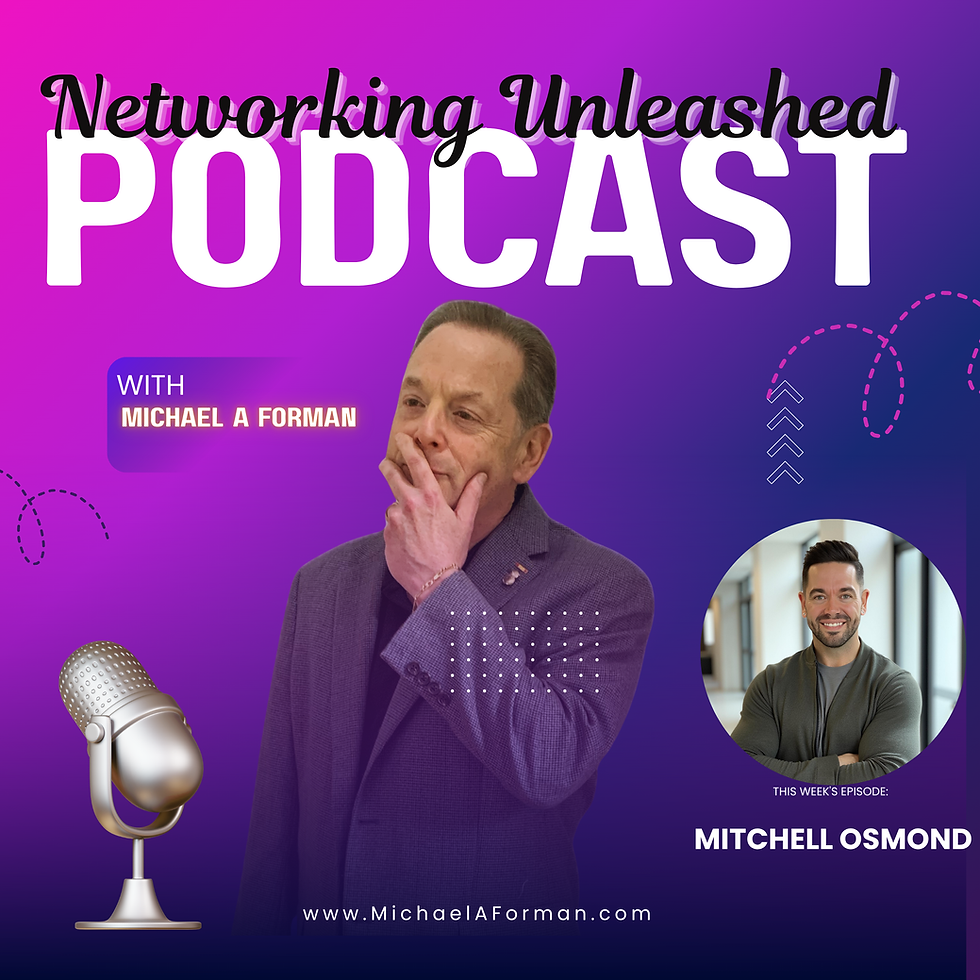
📍 Welcome to Networking Unleashed, building Profitable Connections, the show where stronger relationships create stronger results. I'm your host, Michael Forman. Today we're stepping into a side of networking that doesn't get talked about enough. We usually focus on strategy, conversations, and follow up, but the truth is. How you show up in business is deeply connected to how you show up in life. My guest today works with men navigating careers, marriage, fatherhood, and the pressure of trying to handle everything at once. He teaches that mindset, responsibility, and present presence. Don't just shape families, they shape leadership. Credibility and trust in professional relationships. We're going to talk about why past experiences affect how you approach people today, and how emotional maturity impacts opportunity and why. The same qualities that bring a life bring a strong home, often build a strong network. So if you build, if you want better connections, better conversations, deeper trust and relationships that last beyond the transaction, you're in the right place. I'd like to welcome to my podcast Mitchell. I'm really excited about what you have to offer my listeners. So why don't you just introduce yourself and a little bit of how you got here today. Thank you, Michael. I appreciate the intro and I appreciate being here today with your listeners. Yeah, a little bit about me. I'm a coach to high performing career driven men who are, a lot of times I'll say it's the men who wanna reclaim their home, their health and their happiness without sacrificing career success. So a lot of us fall into that trap of building the career, building the business, but then. Lose track of some of those things. Like you had said in our marriages, fatherhood our health, our mindset. And so that's largely what I do. How did I get here? I've a wild story of, I came from a and I'll do this as quickly as possible but I came from a background, a childhood of dysfunction. I was raised without a father in the home. There was a lot of alcohol, drugs crime abuse, all those different things. It was very messy. And I grew up to, to become a young man who got married. And I thought I had dealt with all that stuff, but, within three years of my marriage all those childhood wounds began to bleed into my marriage. And it took, it paid the price. Michael, I was always in positions of leadership. I always had, it always made sense to me. Business made sense to me. But yet when I would come home, I just, I didn't have the same skills and I, I felt powerful at work, but powerless at home. And so we, there, my turning point, there were really two turning points for me as a lot of people ask that question. What made you do what you do today? And there was two, one was a fight and the other one was a funeral. Okay. So the fight happened, it was me and my wife, and we were sitting in the living room and on the couch and it just, it hit the fan and it spiraled and the fight got quite heated. And we had fought a lot. Our first three year marriage, three years of marriage were difficult. I was going through a dark season. But this one was different, and I didn't know, like I, I knew deep down, if I didn't fix this, then divorce would just be around the corner. And to give you some more context, Michael, I had recently been let go of a senior leadership position. My career was everything. To me it was my identity. So many of us men wrap our identities around what we do. And and I spiraled, man, like I, I ended up 60 pounds overweight. We were a hundred grand in debt. Now dangerously close to divorce. It was a very dark season for me. And tho that week after having that big fight, I come home from looking for work and I thought, man, as I parked in the driveway, is this the day that IC that I walk in and I see the ring on the counter. It was that and that tense. The second turning point was seven days later, I was invited to sing at the funeral of this wealthy man who's a philanthropist. And I was a professional musician as well, and so I'll never forget, it was about 2000 people in the room and I was getting ready to sing side stage. And as I'm preparing, getting my guitar and all that, I overhear the minister ask the congregation as he talked about all the things this man had done. He had asked the room, are you living a life worthy of imitation? If you were to die today, would you be proud of the legacy that you left? And Michael, from me at that point. I had this huge wake up moment of wow, if this were my funeral, and I picture, I'm like, I'm standing. I'm playing guitar. I'm looking at the casket of this other man. And I'm, and I get this flash of where my life is headed, and I think, you know what the answer to that question is? No. No one would be looking at me if this were my funeral and saying, I want to imitate the marriage he had. I want to imitate the way he took care of his kids and his body and his and finances. Nobody would said at that. And so that day, Michael, I went home and I made a bold decision that I would die to the man that I needed, that I would die to the man that I was. In order to become the man I knew I needed to be for my wife and for my family, I took ownership. And then there was a lot of things that happened that season, but over the next 18 months. I lost to 60 pounds. We completely paid off that a hundred grand of debt restored our marriage. And it was free of distractions and substances and all that stuff. And then since then, man, dedicated my life. I started helping friends of mine 'cause I was in. Leadership and a lot of friends could see that what was going on, right? And they're like, man, what's going on that you're on fire. And so I started helping a lot of people just building budgets or going to the gym, building plans for them or helping 'em get closer to their wives. And until one of my mentors said to me. And if you really want to live a life worthy of invitation, if you really want to have impact, you need to turn this mess into a message and share your story with the world, you need to start a podcast. And so that's what I did two years ago. And then from that came the coaching program. And then from that, here we are today. And that's what I do, man. I help the man. I used to be. I'm a huge fan of Ed Millet. He says, you are the most qualified to help the person you used to be. And that's what I do today. I help high performing men or career-driven men. Reclaim their home, their health and their happiness. 'cause that's who I was. So that's what I, that's how I got here. Great. That's great. It's a wonderful story. It's a success story. It's it's everything that a man. I'm saying it because that's the lane that you're in, but how a man can envision himself and whether he can do better for himself or not. And I think that we'll get into that a little bit further as we ask the questions. You talk about modern masculinity, how does a man's identity at home influence how he shows up in professional relationships? Yeah, that's a great question. Let's talk about modern masculinity first, and then we'll talk about how his home life shows up at in his professional life. I think we're living, being in an interesting time in the age, Michael, where there's more polarization than ever before. And there's more confusion, I would say in the Gen Zs. We've never seen more confusion about what it looks like to be a man in today's society what it looks like to be, looks like, to be a strong, loving husband, and and you think about what on social media, it's either the hard one side of the pendulum where it's like red pill. It's toxic alpha masculinity. It's not great and that but then you got on the other side, there's this sort of soft kind of weak. Sort of a representation of masculinity that where men don't really they're the nice guy. They're not, they're very passive. They don't stand up, they don't really have a spine. And there's not really many people who are playing the middle ground. And that's because. Let's be real. Today's, in today's day and age, clicks get, get likes and likes, help people get paid. And so why would I talk about something boring if I can talk about something polarizing? So let's have an extreme point of view because it's gonna get clicks. And what happens though is then cultural narratives begin to form. And so we've seen now more than ever, a divide. Are you intense alpha, like red pill kind of mentality, or are you. Feminist and just very and very you actually don't really know what your role is in the home. And so for me, the modern man is a beautiful combination of both, of understanding that no, this isn't the fifties and sixties anymore. A roles have changed and yeah, you're gonna change a diaper. Yeah, you're gonna be emotionally present for your family. But yes, you will also be strong when you need to be and stand up for your family. You are both strong like a lion and meek like a lamb. And that's, it's a beautiful balance, but I don't think that many people even understand what that looks like. Now, how does that show up in work? I tell you and people say to me all the time how does this help my professional life? And I would say when you become more emotionally available with your wife and learn how to hold space for emotions and connect with her on that level, when you learn to connect with your kids and be fully present and not be distracted, all those things. You develop those skills, you will be a more present, compassionate, powerful leader because your staff, your employees will feel more seen, more heard, more acknowledged than they ever have been. And so these two are not, it's not an either or, it's a both and. And it's a beautiful combination when you can dial in those skills at home because they do translate professionally for sure. Absolutely. Absolutely. And you hit upon so many things that I can't just take one of them and talk about it because you hit so many. We'd have a three hour podcast. We would so I agree with you wholeheartedly. Every point that you just brought up. Many professionals try to separate personal life from business. Why do habits inside a marriage often mirror the habits inside networking conversations? Sorry, can you ask that question again? I just wanna make sure I answer it the best I can. Sure. Many professionals try to separate personal life from business. Why do the habits inside of marriage often mirror the habits inside networking conversations? Yeah. I think people try and keep it separate and I don't know why. I, people talk a lot about work life balance. I've never liked the word balance. I think that's un unachievable. I like this. I like the word work life integration, because work is life. Yeah. You spent 8, 10, 12 hours a day there. Let's not just let's call it spade. What a, let's call a spade, and so for me, it's so important for us to understand that. Because what happens is we can fall into this trap of of not fully being present when we're home because we're thinking about work, and then when we go to work. We're thinking about our kids at home and we're never truly feeling, we're never truly living this sort of integrated life, and where you're never really present where you are, you're in one place, you're thinking about the other. And so for me, I think that's such a valuable asset to be present where you are in the moments. A lot of times when my, with my clients I'll just say, listen, be where your feet are and wherever you are. Be there, and it's a simple phrase, but the more you think about it and the more you apply it to your life it's profound because it's okay, be where my feet are. If my feet are in the nursery, or if my feet are in my kids' room, then I'm gonna be there with them reading the story. I'm not gonna be distracted about something going on at work. I'm not gonna be on my phone if I'm in the kitchen with my wife. I'm fully gonna be present and I'm gonna be engaging in conversation with her as we're making a meal together. Same applies in business, or be where your feet are. If you're in the middle of a boardroom, be all in. You know what I mean? Don't be checked out. Be engaged with the people who, whether it's your staff members, your employees, or whoever's listening, be fully present, because now more than ever. I think attention is one of the greatest currencies. We can give someone, we can invest into someone because we're living in a world that's there's so much noise and people get drowned out, right? Because whether it's we're hyper connected through social media, through work, through email you never, I literally just said this on a podcast episode that I released yesterday. The average person spends, what is it? I believe it was eight hours a day on a screen. Two of those are social media, but here's another crazy thing. We, we consume up to 140 newspapers worth of data every single day. So when you think about your parents or your grandparents and they'd sit around and read the newspaper once a day, that's one. We consume the equivalent of 140 of those a day because we're so inundated with. Data and information, what's the side effect of that? We're never fully present. We're never fully tuned in because we're being bombarded by digital deluge. And so it's so important for us to be present in both environments and I think that's how they play together. Does that make sense? That makes perfect sense. And really the key point that I took from what you said aligns with networking and it's be present. Yeah. No matter where you are, be present. And that means if you're talking to somebody in a networking event or a one-on-one meeting or anything else, you want to be present and don't let any distraction come into it. An example that I usually give is when you're speaking with somebody and that you have that person walking behind them that you really wanted to talk to, and like your eyes are always darting and oh, I, I wanna watch where he goes because I want to get to him afterwards. The trouble is people don't do that. You have to stay in, in the conversation. Where you are. So you be present, finish that conversation, then you can go to the other person. But if you don't, that person you're speaking to now, he'll say, oh, he's really not interested, or he doesn't care, or, and I don't want to be the person that I don't care. Because I care about, just about every conversation, whether I put a high priority or low priority, that's up to me. Yeah. I want the other person to feel present. Yeah. And let's park there for a second, Michael, because here's the thing and I talk about this often, but here's the message that you're sending. So if you're in a networking event and you're looking at some people behind them, what you're subconsciously, what you're saying is everything going on behind you is more important to me than you, right? If you're with your kids and you're scrolling your phone, what the sub subconscious message you're telling them is, what's on this metal box is more important to me than you. Right when you're watching the game and your wife is trying to talk to you, trigger alert that subconscious message you're sending your wife is, whatever's on that TV is far more important than you. And these are not things that you would ever speak with your mouth, but they're things that your actions communicate. And so whether it's networking or at home, these are important because this is how it makes people feel and it's becoming more and more rare. To genuinely lock in with someone and make them truly feel seen and to feel heard, and to feel like a priority. And so I say this all the time. The bar has never been lower. The bar has never been lower. Like it's so easy to be present because so few people are, and you give them your genuine attention. And it's and it's like, it feels like a cold glass of water to someone who's dying of thirst. It's a beautiful thing. But I tell people all the time, I'm like, please work on this skill because it is one of the biggest things, one, one of the biggest levers you can pull if you really want to care about those who are in your life, whether personally or professionally. So I'm with you, man. Absolutely. And this is where the old saying actions speaks louder than words. Yeah. And so your actions are everything. Your mindset matrix focuses on rewriting past beliefs. How do old experiences with rejection or criticism affect how someone approaches networking today? You know what? That's a great question and I think, that's one that I talk about a lot with men because so often we find ourselves as men living in the past, right? So the mindset matrix is this three dimensional look at your life. So the first and it's backwards because everyone thinks, we're always looking forward to the future. And the past is behind us, but what we do in my work is actually we flip the model on its head, and so we start with the past and we redefine the past. Because it's so important, because whether you realize it or not, your past is shaping your present and is certainly determining your trajectory in the future because up to 80% of the way you see the world and the way you see yourself is formed before you're 12 years old. And so we have these 30, 40, 50-year-old men. Who are still using these narratives that they adopted, these insecurities that they've adopted from when they were 10, 11, 12 years old. And they're just, they're shaping the decisions they're making today. And that sounds crazy to think that way, but that's, psychologists would agree that's the way it works. And so what do we do? We begin with the end. We begin with the past and we begin to speak. To what happened to us and identify what, why we think the way we think, right? Because that informs our present decisions. And then we speak to our future and say, okay, now we're gonna, now that we've re corrected the past, we're gonna change that narrative so that we change that our trajectory. We, the three dimensional model is we redefine your past, we rewire your present. And then we reclaim your future, right? And so the reason why this is important, because we all have these self-limiting beliefs. I don't care who you are. We have self-limiting beliefs. You are like, some of us struggle with the imposter syndrome. Some of us struggle with self-sabotage because we believe these lies. Who would listen to you, right? Or you're not good enough to do this. Or you missed your chance, it's over. Or, you're too old to do this now, for me, and lemme tell you, share a little personal story, why this is so important and so profound is 'cause Michael, when I was growing up. So I have a DHD and I was actually just diagnosed with this a couple months ago. And and it all makes sense now. I grew up and my family always said your sister is the smart one. And she was six or seven years old, but she was really or older than me. Sorry. But she was always really smart in school. But because my brain didn't quite operate the same way I didn't do that well in school. I really struggled. And so I grew up thinking you're not the smart one. And now I never really questioned that until I was about 20, I would say, no, probably about 31, 32 years old, where I was planning on launching a podcast. Then sure enough, what happened that limiting self-belief came up? Who would listen to you? Why in the world should you start a podcast? You're not the smart one. That's your sister, right? And so Michael, I spent three years trying to muster up the courage to do this and to launch the coaching practice. So what did I do? Because I have A-D-H-D-I had to do something and get it all outta my head, and so I sat and I wrote content frameworks, systems, topics for three years. I have a Google Doc that has over 800 pages of content. I just didn't have the courage to pull the trigger 'cause I was still wrestling with this limiting self-belief until finally when I did so people were like how do you get the content for your podcast? I got two novels worth. But that's what held me back and until I really unpacked that and I called out the lies. And I spoke truth into them, it completely sabotaged so many parts of my life and it took because of that, it took me three years to make the decision. I could have started a lot earlier. So that's why I think it's so important for us to do that. Does that make sense? It makes a lot of sense. It makes a lot of sense. Way, when I first started my podcast about a year and a half ago. And, I went through, I'm a professional speaker. I go across the country and I speak on stages and everything, but when I wanted to start a podcast, I began asking myself if I started a podcast, who's gonna listen to me? Who would actually spend 20 minutes, 30 minutes, even 40 minutes listening to me? And after a while, my mentor, he said, Mike just do it. Because the first one, listen, I've done over a hundred podcasts and if I went back to the first one, I go, I sound like that. But I started and I got better and better, but all I have to do is start. So that was my, my, my only holding back. Situation. Because I never, I always felt I was good enough. I always felt I had the presence, but I was always thinking who would listen to me? And that's what I had over had I had to overcome. Yeah. You know what, if you don't mind, I'd love to share a framework with your listeners that can help with rewriting these limiting beliefs. Sure. So what I've developed, because this is so common with so many. People even, I work with career driven men, high performers, but it doesn't matter who you are. Some of the most elite guys struggle with the same thing. And this is, this applies to all genders all walks of life, all positions. But it's called the clear thinking process. Okay, so clear. It stands for five different steps. It's C-L-E-A-R. So the first step, see, call out the lie. Okay, this is the story that you're telling yourself. So you literally would write that, the story I'm telling myself about blank is this. And you want to go into much as much detail as possible. You might say, I'm, the story I'm telling myself is I'm just an angry man, or I'm too far gone, or I miss the moment. And that plays like a tape. It's not a truth, it's a tape that's playing. But we can hit stomp on that. The second step in this process is once we've called out the lie is to locate the source. This is critical. So you might say something like, the people that have started this or reinforce the story or the situations that reinforce the story are, and then you fill in the blank, right? The lie or the limiting belief may have come from a parent, a friend, a high school teacher, a bully colleague. Could be anything. But it's important that you name it because once you name the source, you break its power. The third step is CLEE. Evaluate the cost. And this is probably the, one of the most important steps, and this is where we ask ourselves, what has living by this lie cost you? So far has it cost you your peace, your confidence, your professional ceiling, whatever. And this phrase you might write is the results I'm getting from telling myself this story are black and you fill it in, right? And it's important you feel the weight to that, not to shame you, but to get leverage to change it because you're paying a price by believing this limiting belief. The fourth step is a. Which is very important. Affirm the truth. This is where we flip the script, right? We write a new statement that is true about who you are. So the a the question you might ask yourself in this step is, what else could be as true, if not more true than the story I've been telling myself? And this this is, so for example, my story, this for me the truth because I was told I wasn't the smart one. The truth was I'm an intellectual. I'm focused and I have much to offer this world, right? And so I'm rooting that truth and directly negating the lie. The last step is R, which stands for reinforce with action. So this is where you don't just say it, but you live it. And this is the question is, what are three to five negative thoughts, habits, or people that you need to maybe put a pause on or remove? And then what are some actions that you could take three to five actions that can negate that belief. And so for me, a major action to, a step to, to eradicate that limiting belief was actually to launch the podcast, like you said. Like you have to take that step, right? And so that. That process, the clear thinking process is what I have all my clients go through. When they find themselves in a situation where they start doubting themselves. They're about to go into a big meeting or have a conversation with a high level person where they start to feel that imposter syndrome creep up. But here's the thing. I love this quote from Carl Young. He says, until you make the unconscious conscious, it will direct your life and you will call it fate. So what we do is we take those unconscious thoughts and we bring them with a conscious mind, question them, change them, and then change our trajectory. Does that make sense? It makes perfect sense. It makes perfect sense. I like that. Also, by the way and I'm saying this is good that this is video because otherwise I'd be writing down notes. Feverously in networking, people often try to impress. What changes when someone focuses instead of on responsibility? What changes when someone focuses instead on responsibility and consistency? Yeah. I think so many people focus on being impressive, and so what happens is they. You're having a conversation with someone and they're talking and you're thinking, how can I impress them? What, how can it be interesting? What's the next big thing I can say that will blow their mind and make them wanna work with me? Or, whatever the case is, right? And it's totally backwards. It's totally backwards. 'cause here's the thing. And I do genuinely, firmly believe this to be true. It's so important for us to focus on being interested, not interesting, okay? No one ca you know, we know this old adage, no one cares about how much and so they know how much you care. We think, how can it be interesting? I said no. It's not about you. How can you be interested in that person? In their life, in that situation, in this moment because the people that think, man, he's here, he's interested in me. That's the stuff that moves the needle. That's what leaves an impression. Not your fancy revenue projections or the capital you raised or this business model you're about to release. And I think that's a trap we often fall into. And, so I'm constantly telling myself that, man. It's don't be thinking, don't be interesting, be interested. Don't be interesting, be interested. And I think that it can, whatever situation, whether you're working with a client, you're at a networking event, you're working, you're having a conversation with your boss even, whatever, right? Like it's such a powerful concept that I think so few people fully, maybe they understand, like a lot of these things we're talking about, we intuitively get, when you say it out loud, you're like, yeah, that makes sense. But the few who actually implement on that, those are the ones who, who really see an impact. Yeah. It's when you go to a, I'm saying a networking event since that's what I'm all about. But you go into it with what's called a servant's heart. Yes. So you go in thinking what you can do for others, not expecting anything. And I, a lot of my clients, they say if I'm going to this networking event, I put some money down. I want to sell. And I'm like, no, that's completely wrong, right? You want to go in, you want to ask interesting questions, but go in with a servant's heart to see how you can, one line that I use more times than not is when I have somebody in a networking event and I hear everything. I have a bunch of things that I go through, but I say, how can I make you more successful? How can I be a good referral source for you? And if I did my job correctly, they'll say, Michael, I don't know what the hell you do yet, and you're already trying to make me more successful. Yeah. And that's going in with a servant's heart. So if you do that, everything you just said all comes together. Yeah. And I think, for that too, it's the moment, like even if you're con thinking in the back of your head what can I get out of this conversation? What can I get by being here? If that is the filter, I think every, you can smell that, you can sense that in a conversation. And what goes from what could have been a beautiful beautiful interaction that leaves someone walking away feeling like you've invested in them or serve them. It turns it into a contract, a contractual thing where it's okay, I'll do this, but if as long as you do this for me, right? And that's not what you want. So there's this servant hearted approach. I love that. That's what we're called to do, I believe and to make relationships, to make people, to make the world better than when we left it. I agree with you, Manam. Absolutely. And plus it, it takes all the pressure off you, right? Yeah. It takes everything off and you can go in and have a good time. Yeah. And that's really what it's all about. You're being yourself, you know you're being present. All that comes in when you have that mindset to change in mindset, and if you have that servant's heart, then everything changes. You think about it, Michael. Sorry I just, we were talking about, because it's such a good point. You think about how exhausting it is to be trying to listen to someone talk to you while simultaneously thinking, I gotta say something great. What can I get out of this? What can I say that's really gonna take me to the next level? That's tiring cognitively versus hearing someone talk to you and be like, man, tell me more about you. Tell me more about your business. What are you passionate? What's working for you right now? How can I help? That's just so much easier, right? So it's like, why not? It's a win-win. Yeah, it's a, and people love to talk about themselves a hundred percent, and so if you get to a conversation and have the other person talk about themselves, it's, know you, like you, trust you, they'll do business with you. So that trust factor when you're talking to them and talking about themselves, that trust factor. It's going up and that wall between the two of you that's coming down a hundred percent so it becomes perfect. Okay. For professionals feeling stretched thin between family and career, who can they build meaningful connections without sacrificing what matters most at home? Yeah, that comes down to, they. This is the tricky thing that we all fall on. This is a huge question because I think we all fall into this. It's we want to have a great home life. We also want to be successful professionally. We all want those things. And I think the answer is riddled or woven throughout. The things that we've been talking about today. But I think it's so important for us to, because really what we're saying is how can we see success in it all? Not sacrificing career, not sacrificing family. And for me, that just comes to having strong boundaries, in your life. I did a, an episode about this last week, just how we don't necessarily do an audit of our time and our energy. And so we give away our energy and our time to things that maybe aren't moving the needle or don't matter. And then we don't have energy for the career or for the business or for our families. I call them energy vampires. They just vampires suck your blood energy. Vampires suck your energy, right? And it could be relationships in your life that you're just, and we all know, like we all got those people when they send you a, when you see a text come up, you're like. Oh, here we go. Or they get a phone. You get a phone call coming, you like, do I want to answer that? Whether it's energy vampires through relationships or whether it's through. Digital boundaries, right? I believe phones can be energy. E vampires, email can be energy vampires, all those different things. And so to set up boundaries to say no I'm gonna work, I'm gonna shut down at this point. I'm gonna have to close my laptop. And then, another one would be digital boundaries. Career boundaries and relational boundaries are really important. The reason why is because if your energy is constantly drained, you can't give, like the man who's trying to do everything accomplishes nothing. He's just average at a lot of different things. So you're not gonna see the success professionally. You're not gonna see the success at home personally either, because you're never actually fully where you truly, you're not making people feel included and seen and heard, and all these things that we've talked about because there's so much noise in our lives, right? And so for me. Is an ex an exercise that I think your listeners will benefit from. I walk my clients through something called the life report card exercise because we fall into this trap of constantly trying to do too, to too much, right? And you think about it when you were growing up four or five years old, we start school, we go for what? Over 10 years, 12 years in school, and the whole objective is. Get straight A's, be the best in every area. We get out of there. We go to university. What's the goal? Straight A's. Be the best in every area. So what happens when we get a mortgage? What happens when we get married and we try to maintain our health and we get a career and we have kids and we bills, and we get all these different things. We get straight A's in everything, be amazing at everything. Problem is we try everything and we're successful at nothing. And so the report card exercise says, Hey, I'm gonna walk through the different subjects of my life and I'm gonna give myself permission to be a B, maybe a B minus. C plus, you might have to put something on the back burner for a season because it's not that important to you in this moment. For example, before I had kids, I would train six days a week in the gym and I'd be there an hour and a half. Hour and a half. I could sit in a sauna, sit in a massage chair. It was great. I could be an A plus in fitness. I got two kids. It's different. I a marriage business, all those different things. So maybe my fitness is a b plus, but hey, Lisa's still on the report card and there are gonna be some things that you might dare. I say you might actually have to give yourself an F in because this is not serving you and it's no longer serving you. So you're gonna say, you know what, it's a fail and I'm not even gonna try because I don't know even know why I'm entertaining this in the first place, this relationship or this, the social media that I'm bing. Wasting time. You know what, that's an F and that's fine. So give yourself permission to give yourself that accurate report card and then that will free up space for the very few things that you want to be an a plus in. Does that make sense? Makes perfect sense. In business, at the end of the year, I see what worked. This past year and things that didn't work, the things that didn't work, obviously I got an F in and I just get rid of it. I say, okay, I'm gonna chop that off and I'm gonna create something new and see how that works. So I do that. That's a, that's an exercise that I do at the end of each year, around October, November, I start to think about it, and December I make those decisions. So yes it's true. I know about, I have two kids myself, probably a little bit older than yours. 31 and 35, but when they were growing up, look, I managed both their little league teams. So that was the decision I had to make. I could chase the dollar. Or I can take the time off, be with my children and manage the team. So I, I made the decision to manage the teams. So I didn't make as much money, but the, what, the happiness I got from my children was you can't put a number on it. So that's what I. And I think that's the thing, right? We kill ourselves doing too many good things. And that's the thing. They're not bad things we're trying to do. I was talking about this with a client the other day and I asked him the question, what good things do you need to remove from your life to make room for the best things? And only you know what the best things are, is that old adage, good is the enemy of great is the enemy of the best, right? And so you can completely burn yourself out doing all really good things. And that's the tricky part. What gets your Yes. And what gets your no right. And so give, get really comfortable handing out lots and lots of nos so that the things that you give your yes. Get all of you. And that's how you're gonna see success both at work and at home. Absolutely. Absolutely right. Let's bring this podcast full circle. If someone wanted stronger relationships in their family and their business in the next 90 days. What's my, what's one mindset shift would make the biggest difference? Yeah, that's good. You know what, and I'm tempted to just give you some strategy, some framework that I've created, but really the thing that's popping up to my mind as a quote that's just shook me like six months ago when I heard it. Time, is the only currency that we spend without knowing the remaining balance. What that means is, Michael, I don't know if I have 60 years or 60 minutes left to my life now, if I live with that kind of awareness, how much different would I be treating those around me? If I knew that I have six days left, 60 minutes left, what would I say to those? I love. All those different things. So for example, just share a personal story. My, my nephew was 18 years old and two years ago passed away in a drunk driving accident, and right before he put the keys in the car he was sitting around a fire with his buddies. I don't think, obviously he didn't know that he was living in the last 60 minutes of his life. But what would he have said? What would he have done if he'd known that this is the last hour that I'm gonna be on this earth? And so for me, Michael, time is so precious and we give it away to the stupidest things, the most frivolous things. We waste it constantly. And so my challenge and my mindset shift that I would encourage listeners with is, you don't know how much you have left. So spend it wisely. Spend it on the things that matter. You know what I mean? If you're at work, be where your feet are and just connect with those people. Make them feel seen, make them feel heard. And if you're at home, put the phone down. Talk with your kids, talk with your wife. Make her feel like you're fully there, that she's cherished, or with your husband. And if you're a woman listening, make him feel like he's a priority. And I tell you, your relationships, your career, your own health and wellness will be much richer for it. And so that would be my encouragement because every once you do that, everything else gets better. So I can't agree with you more. Everything that you've said, everything you've brought to light made me think of things that I didn't even think of, and I have made the decision where I am today. I went from being in the military to owning my own business, to going corporate, to going back to my own. Business and all e every time I shifted it was a whole mindset shift. But everything you said came into fruition. It just, it's conjuring up memories and things and it, you were just so on point with just about everything. Mitchell, how can somebody get hold of you if they want to be coached by you? If they wanna say hello to you or what's the best way for them to get hold of you? Yeah, the easiest way is to check out the website is just dad nation code.com. Or honestly, if you just Google the Dad nation you'll see my face plastered around everywhere. You can just go on the website and my email's there. There's a form you can fill out. Would love to connect with you. And whether it's just a. Candid conversation about where life's at for you, what's work and what's not. Or if you wanna take the step and actually work together, I'm happy to have that conversation as well. But really at the end of the day, I've dedicated my life to helping 1 million men reclaim their home, their health and their happiness through media and mentorship. And that's what I do. That's the two things, media and mentorship. And that, that's the simplest way. And I'll tell you what, I'll give your listeners a free gift if you're okay with that. Sure. It is just called the connection code. And it's, what it is it's a PDF. It's 50 questions that are designed to spark the fun and get the fire back in your relationship. Now, that's because the reason why I developed this tool is because we know that, for example, 80% of the main reasons cited for divorces today in the US is. The main reason is not kids. It's not abuse, it's not cheating, it's not anything like that. It's emotional disconnection. And by the way, 70% of divorces in the US today are initiated by the women in the relationship, which is significant. Yeah. So what does that tell us? It gives us a big beacon that our partners crave emotional connection. And so these 50 questions are strategically designed to help connect with your partner on an emotional level to go from feeling like roommates back to soulmates. Very simple. The only thing I ask guys to do is, Hey, you, when you take her out on a date, pull three or four questions off the page and ask them to or if you put the kids down, pour a glass of wine, pull some questions off the page. And I'll tell you, Michael, I've had women email me the day later the next day after a date, and I'd be like, who was this man? Who was asking me these questions last night. And the cool thing is, there's stuff, everything from like your dreams to just fun stuff to intimacy. But you can actually, there's a big section on this list that you can use to ask your coworkers to connect with them or to ask your children to be fully pre. We talked a lot about presence, right? These questions will draw you into each moment. So you can just go to dad nation code.com/code. And you could download that for free, or I'll give you the link to it and you can put it in the show notes. Great. That's great. Mitchell, this was great. This conversation is a reminder that what networking isn't just a professional skill, it's a human skill. The patience, consistency, and presence that strengthen a family are the same qualities that strengthen business relationships. Take one action this week. Choose one relationship at work or at home and give it your full attention. A genuine con conversation, a thoughtful follow up, or simply being present can change more than any technique ever. Will. If you found value in today's episode, be sure to like, follow and subscribe to Networking Unleashed, building Profitable Connections, so you keep getting practical insight on networking and communication and share this episode with someone balancing career and family and who can use it. If you'd help improving your communication, leadership presence, or the way you build relationships, visit michaelaforman.com to learn how I work with professionals, teams, and organizations. Mitchell, I have, I want to thank you again for coming outta my podcast. You are a great guest. Thank you so much, Michael. It's been an honor and a privilege to be here, brother. Well, hold on folks. Don't go anywhere. Let's hear from our sponsors. David Neal, co-founder Revved Up Kids. Revved Up Kids is on a mission to protect children and teens from sexual abuse, exploitation, and trafficking. They provide prevention, training programs for children, teens, and adults. To learn more, go to RevD up kids.org. Henry Kaplan Century 21. When it comes to making the biggest financial decision of your life, leave it in the hands of a proven professional. Henry Kaplan Henry is a global real estate agent with Century 21, celebrating his 41st year in business. No matter where you're moving, Henry has the right connections for you. You can contact Henry at 5 6 1 -4 2 7 -4 8 8 8. a huge thank you to our guests for sharing such incredible insights today, and of course, a big shout out to you, our amazing listeners, for tuning in and spending your time with us. If you're interested in my digital courses being coached or having me come and talk to your company, just go to MichaelAForman.com and fill out the request form. Remember, networking isn't about being perfect. It's about being present. So take what you've learned today, get out there and make some meaningful connections. If you've enjoyed this episode, please don't forget to subscribe. Leave us a review. Share it with someone who could use a little networking inspiration. Let's keep the conversation going. You can find me on Apple, Spotify, Pandora, YouTube, or my website michaelaforman.com/podcast.
Michael is a business networking expert specializing in enhancing professionals' networking and communication skills to drive profitability. As a leading authority in this field, he is highly sought after for his dynamic presentations and workshops. His extensive experience has consistently led to significant improvements in corporate profitability by empowering individuals and organizations to connect more effectively and efficiently.
Digital Courses


Comments