
Networking Unleashed: Building Profitable Connections. An Interview with Curtis McCullom and Michael A Forman
- mforman521
- 2 days ago
- 20 min read

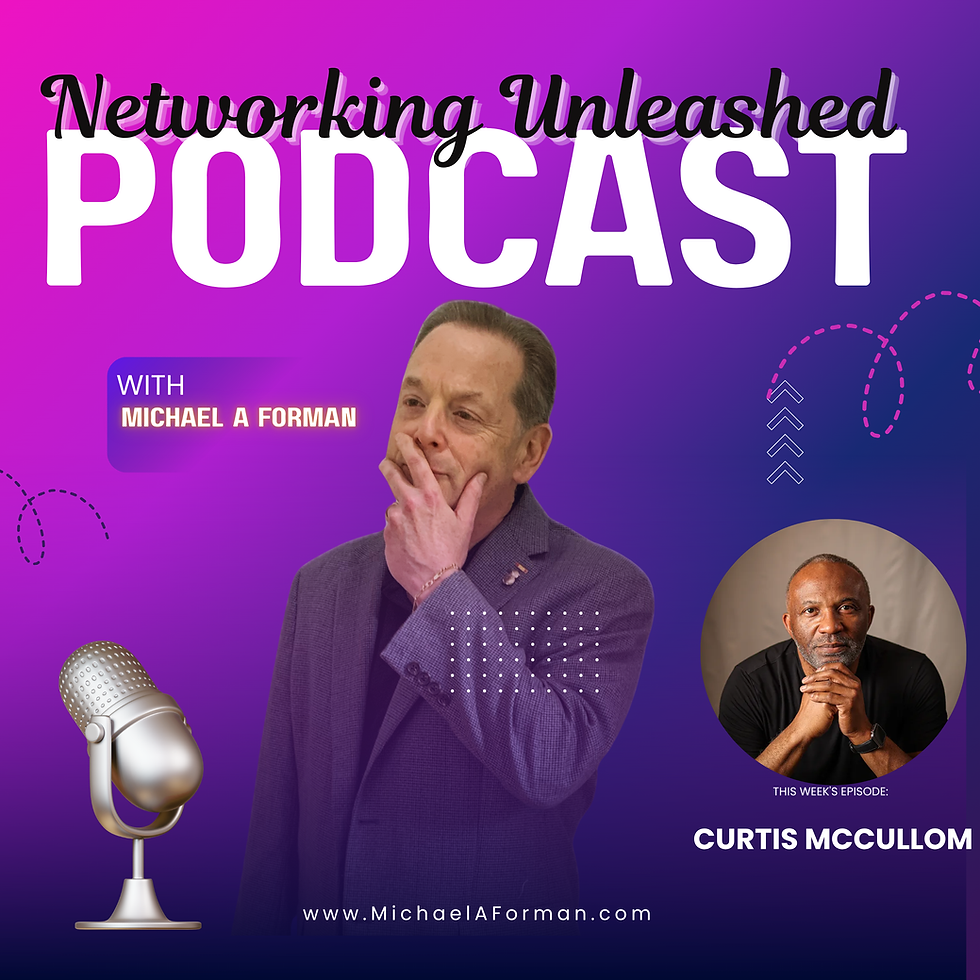
📍 Welcome to Networking Unleashed, building Profitable Connections. The show where relationships grow your business, and conversations create opportunity. I'm your host, Michael Forman. Most people believe networking success comes from better scripts, better strategies, or saying the right words at the right time. But what if the real issue starts long before you ever introduce yourself? My guest today teaches that the quality of your connections is shaped by something deeper. Your internal beliefs, your presence, and the energy you bring into a conversation. In other words, networking isn't just about what you do, it's about who you are being when you do it. We're talking about why conversations stall, why some people instantly build trust, and how alignment with your values can naturally lead to referrals, partnerships, and clients without forcing it. If you've ever left an event thinking, I did everything right, so why didn't anything happen? This episode is for you. I'd like to welcome to my podcast Curtis Cullen. I am actually very interested and eager to hear what you have to say, but please introduce yourself and give us an idea of how you got here today. Thank, first of all, thank you, Michael for having me on your show. My, my journey actually started about 40 years ago. I went into sales. I wanted to become a motivational speaker. Back then, it was a sales trainer on motivational speaker. So I listened to all the greats, Tony Robbins, Zig Ziglar Tom Hopkins, Dennis Olos, guys, and I became number one in sales and financial services. I didn't become a motivational speaker. I did do some teaching and stuff, but I stayed in financial services for about 35 years. I tell people all the time. You don't have to stay in something that long to find out what your passion is. You can do it much faster than that. But after 35 years plus, we were in a position for me to retire from financial services. And my wife says, okay, what you gonna do next? And I'm like, okay. She says won't you do what you've always wanted to do? That is help individuals transform their lives. So I got a certification as an executive coach started doing some coaching and I hated it. I'm like, no, this is not what I do. This is not who I am. Because I've always utilized hypnosis, neurolinguistic programming, those sciences in order for me to actually help people build rapport and build businesses. And so I went back and got a certification as a clinical hypnotherapist and also a certification as a master practitioner, neurolinguistic programming and mental and emotional release. And I combine all of those modalities together. What I now formulated. As the legit mindset of learning, growing, expanding, and transforming. That's the framework in which I work from Now that sounds great. I'd love to know how you do it, and I think I'm gonna find out about it. You say most networking problems are tactical, but internal. What is actually happening inside someone before they even say a word at an event. Usually what happens is that they see sense and they don't see sense and feel themselves actually connecting. What people have to understand that communication is only 3% is verbal. Other 97% plus is nonverbal. Meaning, so how you show up at the presentation gives the person on the other end an indication of who you are. So one of the things is, what we talk about in neurolinguistic programming is mirror and matching the person so that your energy kinda matches the person that you're meeting. I got really good at this. I formulated. I think what I call the rapport factor, where I believe that the sale is made, a sale is usually made in the first 30 to 60 seconds of a presentation, and the rest of it is just now just actually button the presentation up. So the whole idea is presence. How I see, sense and feel myself first and now. Can I transfer that over to the other individual? Yeah, and you're absolutely right. 'cause the first 30 to 60 seconds is so important in the networking world, right? If you go to a networking event, that 30 to 60 seconds when you first go meet up with somebody, right? Will tell you whether or not the other person is actually going to talk to you or talk at you, right? So that's the difference. So that's very good. How does a person's subconscious belief about themselves quietly shape the kinds of relationships and opportunities they attract? You think about it, we can't perform any. Higher than what I subconscious have already been programmed to do. And this is the big one that most people don't really understand. I think even in, we're talking about communication, but now the subconscious mind of the mind, how the mind works. Only 5% of it that, that, that's conscious, right? Is the willpower, the analysis and all of that. So sometimes when we go to networking events, we're doing willpower, we're doing all the things that we think we should be doing or saying, but our total communication is on a subconscious level. And that's 90%, 95% of all our behavior. The challenge is this, is that some of the things that we've learned, some of the programs that we actually run, we don't even know that they're running. They've been running all our lives and so we don't even know that program is a faulty program. It's almost like a computer program. You get you, you get these error messages, right? That something is gone awry. And that's the same thing we get when we go to networking situations or meeting new people or in any, in a relationship, is that the evidence that the program is not working correctly is the feedback that we're actually getting. So the part of that pro problem is that you think about, I'm coming to meet you. I'm seeing you. When I look at a person or Mike, I'm looking at all these micro movements. I'm looking at these small little nuances. They're the eyes, the way they're holding their body. Am I actually connecting with them or not? And so all of those little things help with the communication. But what blocks that is our own personal beliefs and our own personal values. And most of it we don't even know it runs. Is it possible to change? Is it possible to practice the correct way and get better results? Oh, absolutely. Ba, basically, the thing about it like this is that if we create it if we created whoever we are right now, whoever you are in your journey right now, that's who you are and it's okay. The beautiful part about it is that if you created that, guess what the beautiful thing is that you can now recreate it. It is basically, now you can say, okay I'm determined to become a new version of myself. What is it I need to get rid of? What is it I need to let go? What do I need to actually now become who I want to become? That's the beauty part about what I do is we help individuals figure out what is that program that's running so that we can reprogram it and we rewrote, reprogram it through with, through the hypnosis, through neurolinguistic programming, through then we get rid of all the old baggage through mental emotional release. So absolutely, and that's the power we have is that we can recreate it. But the thing about it is this, Mike. Michael is that we have to acknowledge that. We have to be willing to say, this is where I am, this is where I'm now, and acknowledge it and that's the, that's part of the beginning of the healing process, it's anything else. You have to first see that you have a. Problem. Let's call it a problem. Yeah. We can for conversation. Yes. You have to first see that you have it. Yes. Before you can fix it. Yes. So if you don't think you have it, you're not gonna fix it. Oh. And in the other part of that, then now you have to take responsibility. For where you are in your life right now. That's the hard part. Because we want to blame our mother, brother, sister, cousin, on our nephew's side of what had happened in our lives. Regardless of what they did, they basically maybe influenced it, but you still have to accept or decide what, how you want to respond to that. And you have the power to respond. You have the responsibility to noun, to accept it and change it. Okay. Many people learn scripts and conversation techniques. Yes. Why do those sometimes fail even when they've been executed correctly? More than lightly. They were not executed correctly. They said them. They said the words right. They said the words. They said the words they said the right phrasing. Think about it like this, where if I, if I came up, I walked up to my wife, I go in, in front of my office, go to my wife, and I tell my wife, I love you. Yeah, I said it, but the delivery was not communicated that I truly love her. But if I look her in her eye, it would make truly eye contact. And I said, sweetie, I love you. Same words, different meaning. Yes. So think about it like this. If a person walks up to somebody and, want to introduce, I'm Curtis McCullum, I help individuals, overcome their blind spots da, whatever. I say, how I deliver that. Will it connect with them or not? That's the key to it. He's yeah, I might say the right words. Am I saying it in a way that they will respond to it? Absolutely. And being a professional speaker, I go all over the country talking about networking, communication, leadership, the whole thing. But I really, I learned all my timing from comedians. And you, 'cause they have the best Of course, if they're good comedians. Of course. Yeah. Yeah. The best. Timing of anybody. So if you sit there and watch the comedians, you wait for the response, you wait and whether or not it falls short. Yeah. Or whether or not it worked. And there've been plenty of times when I was on stage saying, oh, that didn't work. And they gotta laugh out of that. And I moved on. But I knew not to use that anymore. That's where, but you're absolutely right. It's the way that you say it will take on different meanings every time. Yeah. Basically we talk about vo voice tonality, right? It's it is so it is like the voice tonality. How are we saying it? How are we delivering it? Is the tone. Sometimes with my wife, 'cause I have a big voice, she's she, sheku reminds me, boy, that sounds harsh to her. 'cause she doesn't like a lot of noise and have talk really big. And so I have to watch how I communicate with her because of the fact that I realize that I do have a big voice. So that's the key to it too. It's like it's a science. It's like really, truly, people need to try this. Is that you can literally sit across the room. And watch a person, watch their mannerisms, watch their movements, and start to move your body, like their body, and then you would instantly come into rapport with them instantly becoming rapport. And then what? What I used to do, especially back in the day when we used to have cold calls, right? People don't do cold calls anymore, but back in the day when we used to do cold calls. So I'm listening to the person on the other side of the phone, right? If I say hello might speak to Joe and if they said, this is Joe, I said, then I will lure my voice. Hi, this is Curtis McCullum, right? So basically I'm mirroring matching their voice so that now we have some familiarity so that they feel like I already know 'em. So basically some of small things like that. Watching a person's movements, watching a person's, what they're doing will now, if you can mirror and match some of those things, that now instantly brings you into rapport, and rapport is the key to it. Pe two things that has to exist, as you well know, Michael you pro at this, is that a person has to like you and they have to trust you. And how can you get that done in, in 30 to 60 seconds? Know you, like you, trust you, then it'll do business with you. Absolutely. And you're right, that trust factor, it's the last one in the line, but the most important because nobody's gonna do business with you unless they trust you. So it's something you have to communicate though. There's something you have to communicate so that they can, so you have, you don't have a lot of time. This time sensitive. It's like you have, sometimes you have one shot at this thing, one shot. So how can you shoot your best shot? Number one, you have to, as Tom Hoskin used to say, you have to practice, drill, and rehearse. You can't do it. You can't do it at the event. You need to do it before the event. You need to practice this. Adding onto that. Adding onto that, because what you said is profound, right? It's exactly. If any of the listeners are listening, listen to, to, to Curtis, because that's exactly what you do. But I'm gonna add something to that. I'm gonna say, look in the mirror. Oh, absolutely. Yeah. Look in the mirror for your facial, for your smiles, because you might be thinking, you're smiling and you're not. You're deadpan, right? And you're like why? Why are you reacting like that? Practice that, smile that over, smile that high or something else in the mirror, and you'll laugh at yourself first, but you'll get better and better. This is a talent it's something that can be practiced. Yes. And if you practice practice, you'll actually get good at it. Yeah. And that's the whole idea. Most of us like the we read the script once, and then we deliver it to ourselves, but we don't practice it. And then this is the, another thing that people have to understand is that they need to practice it in different mode, in different learning modalities. Lemme give you an example of what I'm saying. If you're listening to someone and they say, wow, that really resonates with me, that means that they are a very tone type of person. They like sound. So that's the language you need to be using with them. So that if you using language can you see what I'm saying? And they don't see it because they, you didn't tell 'em they heard it. So this small little things like that when you're talking with someone for the first time, listen to their language, listen to how they actually communicating with you and that's how you want to deliver your script. Based on how they communicate. If they says, wow, it is really good to see you, and man, this, can you notice all the visuals? And now they're a visual person, so you know so then you're delivering yours. I'm Curtis, I'm, I work with bespoke potential coach. I help people see the way, who help people see the value that they have with inside of them. And then if they talk about feeling language, I'm gonna use feeling language. I'm, they're talking about Morey language. You're gonna say, I help people resonate with themselves. I help people really know and understand how that, that feeling vibrates within them. So basically the language is so important. So all these little things we can do to get that 1% better, right? That's what we're talking about here. Yep. Get that 1% better each time. 'Cause you know you don't wanna get 1% better and stop now that won't be good. You talk about energy before strategy. Yes. What does someone communicate to others in the first few seconds before introductions even begin? One of my one, this is my, part of my philosophy is that selling is not selling. Selling is transference of energy. What I mean by that is, is that it is that it is like what we, the persona that we have is actually already transferring to the other person. Makes them feel a certain way. Have you ever walked into a room right? You walked into a room or this person walked into the room and the room just lit up. It's just wow. Because of the energy that they have. It just make you feel, you can feel the comfort, you can feel the confidence just like dripping off of them because of their presence. That's their energy. At the same time. Have you seen, have you ever experienced a person who walked into the room and just. Sucked all the energy out of the room. Like something about them you just don't like, something just makes you feel not good. And that's the difference. Is that what is, what are you, what type of energy are you actually communicating when you walk into the room? Do you light it up or do you suck the energy out of it? Absolutely, and I can give you circumstances, I can give you examples of each of them in different networking events, but we'd go have a two hour podcast. Okay. How can someone recognize that their internal state, not their skill is the real reason? Conversations keep stalling. Once again, we talked about it before, is that number one, it is a skill that can be learned and it also is a mindset that needs to be tuned, right? So the internal state part of it is, how am I showing up? What am I feeling? How do I actually see myself, you know it, what's, what type of self-talk do I actually deliver to myself? Internally do you saying, I'm not good enough, I'm not worthy, I don't think this is going to work. What type of what? What are you saying to yourself? So that's your internal state, because your internal state, what happens is that, you're, when it go, when you filter this stuff in, it's gonna go your state, your, the way you sit, the way you feel, all that, all of that stuff works together. So it's like. What are you communicating on a level deeper than just the words we talked about? Just the words, but now it's like the internal state. What am I actually seeing, sensing, and feeling in my head even before I say the first words? Absolutely. Absolutely. You connect values, alignment to opportunity. How do people unintentionally attract the wrong clients through the way that they communicate? Sometimes part of it is that sometimes we communicate desperation. Yeah. What I mean by that is that we just want somebody who can fog, a, a fog, a mirror, just a body. The whole idea is that our values is some of our deepest love of programming. And the deepest love of programming basically dictates how we actually see sense and feel our see sense in and feel ourselves. So think about this and with the values is that you know that your values are out of line when you keep hitting a block, meaning income block or a presentation block or whatever it is like. You get too close to it, but then you sabotage or you go back down. It's like this yo-yo type of effect. That means that your values are outta line. And most of us, probably all of us, never stop to say, Hey, what's important to me when it comes to my career? Enlist 4, 5, 6 things that comes to mind so that you know now what's internally, which that, that's important to you, that is so key to actually moving forward. I do a session called the values Alignment where we do that in about an hour and a half, we actually help you determine what your values are so that now you know what programs it's actually running, so you can communicate better. Absolutely. Absolutely. It's probably very interesting too. What internal shift must happen for conversations to naturally turn into referrals, partnerships, or clients? I think the internal shift, it's always thought I, I said one of the things that when I'm doing the sales training is the sale before the sale. The sale before the sale is making sure that I don't have any baggage in my life that's preventing me from actually moving forward. So the biggest portion of it, in my opinion, is starting with me because I'm the one communicating and it's my responsibility to communicate with you, not yours. To me, I'm in control of the communication flow. That means that I have to be at my best in order for you to actually want and desire my, my, my work or my opportunity or my product or my service. That's on me, not on you. And my job is to now to communicate with you in a way so that you want it. How can I do that? Start with me. If I'm totally in align with myself, then now I can communicate with you more in a more powerful way. Okay. I'll go with that. Sure. For professionals who feel awkward or invisible in rooms, what is the first internal change they should work on before any ex external networking tactic? I think when a person feels that, that might, two things. Number one, it might be an indication that there's some baggage. What I mean by baggage is that there is some, something inside of them, some traumas that they've experienced when they were younger. Now it's preventing them from actually showing up in the room, and that happens a lot. It is like some of the work that I do is the symptom that we, that you just described is I don't feel like I'm seen. I'm in a corner. I don't really. Feel but what is the problem? What is the root of that? So we have to determine what is the root cause of that feeling so that we now we need to get rid of the root so that now we can flourish into who you wanna become. One of the things I always share with people is that. Even in my own life, one of the things that I, I was still telling myself even at all the success I've had, that success is hard and difficult. And I learned through some of the techniques that I used, that I accepted and decided that when I was around two years old, when my mom was trying to pot train me, that success is hard and difficult. I didn't know that program was running until six months ago. I knew that every time I would get hit certain plateaus or shouldn't hit certain income levels or some success, I always felt like it was hard and difficult, but I didn't know that language was still running. So even when a person is operating the way the operating, there's probably a reason why. We need to figure out what is that reason. And one of the things, one of the things that a person can actually do for themselves is ask themselves, what is it? What is it that's now preventing me from actually be flourishing right now in the subconscious mind will start to work for 'em. Don't ask why. Don't ask why question guys. You get a why question. Your subconscious mind is gonna take you to levels and places that you don't want to go. Ask yourself what is it, what or how, or what and why Question. So that now it goes through workforce solution for you. Absolutely. And I just wanna bring it back a little bit to the networking event and how you're feeling and everything. And what I do is I teach people to go into it with a servant's heart. Yes. So you're looking to give, not receive. So when I tell my clients, you walk into this event, you don't wanna talk business. There are head spins around like crazy and they go, what do you mean I paid this money to make business? I said, you are, but you're not right away. You're find, you're finding out all about the other person. You're finding out a relationship I use form, family, occupation, recreation, and a certain message. Yes. It what I can because you know as well as I do, people love to talk about themselves. So let them talk. So let them and slowly but surely you'll bring it around to what they do. Absolutely. And that, and it's, that's, so that's important what you just described, the form method is basically what you're doing is listening. Guys, you are listening to their, not only, just also want you to take it a step farther is now listen to the language, how they actually describe their form. How do they describe their family? How do they describe their occupation? How do they describe all these things? Because now what we talking about micro movements, right? We're talking about now getting a little bit better every time because now you can refine it by feeding them back. The same language that they're actually communicating with you with. Is it a auditory language? Is it a visual language? Is it a kinesthetic or filling type language? You start feeding that back to 'em and the connection will just it, it creates this connection much faster and quicker, and I think it's much more lasting. Oh, absolutely. Yeah. Yeah. Okay, so let's bring this podcast full circle. If a listener wants better relationships and better business outcomes in the next 90 days? Yes. What daily habit changes their presence the most? I think the, one of the major things is, we talked about it early in the show, is the number one, acknowledge that everything is not okay. The thing I tell people all the time is Okay not to be okay. But it's not okay to pretend that you're okay and you're not. So one of the major things of change is acknowledging and that's one of the biggest challenges we have as entrepreneurs and CEOs and founders and stuff, is actually to feel like we're weak. If we acknowledge that we're not perfect, we're not. We're not all of that. Okay guys, we're not, and it's okay. It's okay. So if we can first acknowledge, just acknowledge to yourself or acknowledge to a friend, Hey, I'm having challenges in this area. That acknowledgement alone starts the healing process. So number one, in the next 90 days, stop and just acknowledge the fact that I have a deficit in this particular area and be okay with that. Now you can start to work on growing that particular area. I think the person that comes to mind. The most influential it used to be influential is Steve Jobs. Steve Jobs, when he was hiring his executive staff. He looked at his deficits, he looked at the things he was not good at, and he hired people in those sections where he wasn't good at. So he wasn't hiring Yes. Men. He was hiring people that filled his gaps. Yes. And that's why he was so successful. Yep. Curtis, this was great. I can go on for two more hours, ask you questions, but time has its limits. If somebody wanted to get a hold of you to be coached by you, mentored by you, or just to say hello, how would they contact you? The best way to do it is to go to my website. My website basically has a lot of links and have a lot of information there. You can book a free clarity call. 15 minutes just to spend with me and we can call a coffee with Curtis call just to see who you are and how can I help and support you. And then nothing else that happens in those meetings is that I'm gonna give you some value. I'm gonna share something with you to move you to the next step. It might not be with me because, I'm looking for people who are looking for me. And, but my first and foremost thing is helping others become the best version of themselves. So go to my website. You can reach me there. You can also reach me on all social media platforms LinkedIn, Instagram, Facebook. All of them are there. But the easiest way to get in touch with me is through the website at bespoke human potential coaching.com. Curtis mccullum.com. It'll lead you there. Perfect. This conversation is a reminder that strong networking doesn't begin with technique. It begins with awareness. Mi. When your mindset, presence and values are clear, people feel it. And when people feel it, relationships move forward naturally. Take one action this week before your next meeting or event, pause for a moment and decide how you want to show up. Not just what you plan to say, you may notice your conversations change immediately. If you found value in today's episode, make sure you like, follow and subscribe to Networking Unleashed, building Profitable Connections, so you keep practical insight on networking and communication. And share this with someone who keeps trying harder at networking. Needs a different approach. If you want to help strengthening, if you want help strengthening your communication presence and the way you build relationships, visit michaelaforman.com to learn how I work with professionals, teams, and organizations. So until next time, show up. Intentionally connect genuinely, and build relationships that naturally lead to opportunity. Curtis, thank you again for coming on the podcast. You were great. I appreciate it, Michael. Thank you. Thank you for having me. Well, hold on folks. Don't go anywhere. Let's hear from our sponsors. David Neal, co-founder Revved Up Kids. Revved Up Kids is on a mission to protect children and teens from sexual abuse, exploitation, and trafficking. They provide prevention, training programs for children, teens, and adults. To learn more, go to RevD up kids.org. Henry Kaplan Century 21. When it comes to making the biggest financial decision of your life, leave it in the hands of a proven professional. Henry Kaplan Henry is a global real estate agent with Century 21, celebrating his 41st year in business. No matter where you're moving, Henry has the right connections for you. You can contact Henry at 5 6 1 -4 2 7- 4 8 8 8. A huge thank you to our guests for sharing such incredible insights today, and of course, a big shout out to you, our amazing listeners, for tuning in and spending your time with us. If you're interested in my digital courses being coached or having me come and talk to your company, just go to MichaelAForman.com and fill out the request form. Remember, networking isn't about being perfect. It's about being present. So take what you've learned today, get out there and make some meaningful connections. If you've enjoyed this episode, please don't forget to subscribe. Leave us a review. Share it with someone who could use a little networking inspiration. Let's keep the conversation going. You can find me on Apple, Spotify, Pandora, YouTube, or my website michaelaforman.com/podcast.


Comments